
An accessory dwelling unit (ADU) is a self-contained living space built on the same property as a primary home, designed to give family members independence without distance. Families build ADUs to solve problems that traditional housing cannot: aging parents who need nearby support, adult children priced out of the market, and caregiving demands that strain both time and money. ADUs allow families to maintain independence while enabling affordable multigenerational living and supporting intergenerational connection. The reasons why families build ADUs go beyond sentiment. They reflect a practical response to rising housing costs, shifting family structures, and the limits of assisted living.
Why families build ADUs for multigenerational living
Multigenerational living is the single biggest driver of ADU construction in the United States. Families use ADUs to house aging parents who need daily support, adult children who cannot afford rent, and family members with disabilities who require accessible space. The arrangement keeps everyone close without forcing them to share a kitchen or a front door.
The caregiving case is especially strong. When a parent develops mobility issues or early-stage dementia, moving them into the backyard cottage means a caregiver can respond in minutes rather than hours. That proximity reduces the emotional and logistical burden of managing care across town. About 25% of homeowners aged 50 and older have seriously considered building an ADU, often to age in place or assist family caregiving. That figure shows how mainstream this motivation has become.
Adult children returning home after college or a job loss represent another common scenario. A detached ADU gives them a private entrance, their own bathroom, and a sense of autonomy that a spare bedroom simply cannot replicate. Parents get peace of mind without sacrificing their own space.
Families building ADUs for caregiving purposes should prioritize these design features from the start:
- Wider doorways and zero-step entries for wheelchair and walker access
- Grab bars and roll-in showers in bathrooms for aging or disabled occupants
- Single-floor layouts to eliminate stair-related fall risks
- Separate exterior entrance to preserve privacy for both households
- Visual sightlines or intercom systems for quick check-ins without intrusion
Pro Tip: Plan accessibility features during the design phase, not after construction. Building accessibility upfront costs significantly less than retrofitting later and preserves independent living for aging family members for years longer.
What are the financial advantages of building an ADU?
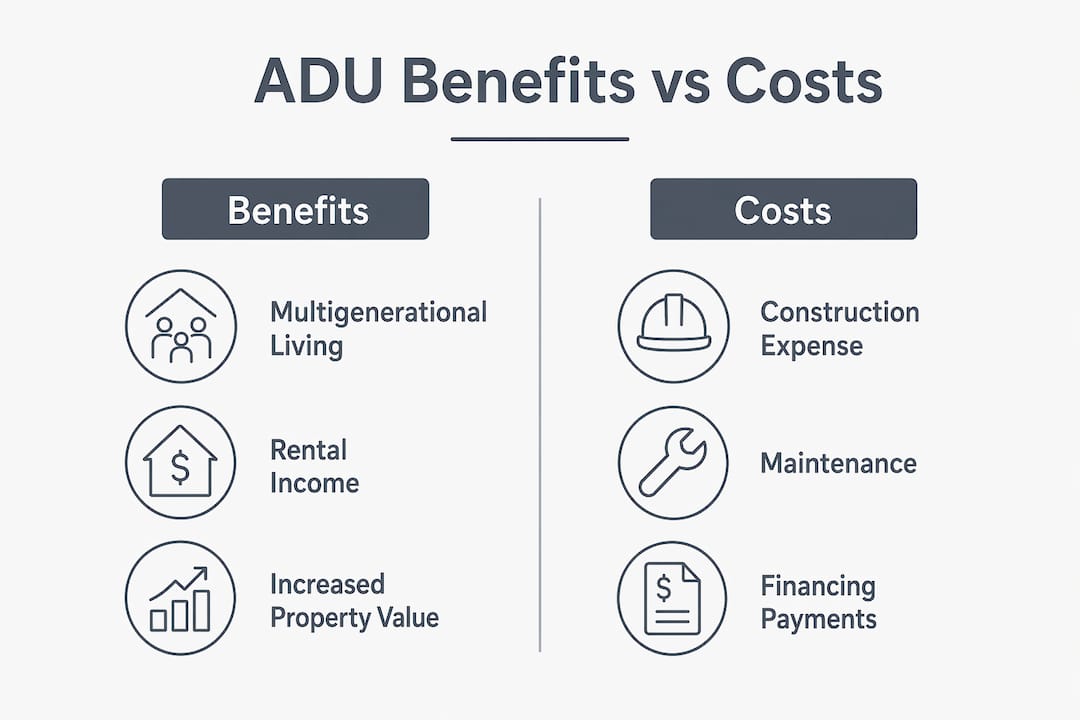
The financial case for ADUs is one of the strongest arguments for building one. Families who rent out their ADU can generate meaningful monthly income that directly offsets housing costs.
Rental income and mortgage offset
ADUs can generate monthly rental income between $1,000 and $2,500 in 2026, depending on location, size, and amenities. In high-cost metros, that income can cover a significant portion of a mortgage payment. Families who practice “house hacking,” living in the main home while renting the ADU, often find their effective housing cost drops by a third or more.

Property value and resale appeal
Properties with ADUs attract up to 80% higher buyer interest and represented over 6% of active listings in 2025 in some markets. That level of buyer demand translates directly into stronger resale prices. A home with a legal, permitted ADU is not just a house. It is a property with built-in income potential, which commands a premium.
ADU costs versus alternatives
The financial comparison between building an ADU and paying for assisted living or a second home is stark. Consider the typical cost breakdown:
- Detached ADU construction: $150,000–$350,000 depending on size and finishes
- Attached ADU construction: 20–30% less than a detached unit, per multigenerational ADU cost data
- Assisted living facility: $4,000–$6,000 per month on average nationally, which exceeds $48,000 per year
- Renting a separate apartment for an adult child: $1,500–$3,000 per month in most urban markets
An ADU built for $200,000 pays for itself in avoided assisted living costs within four to five years. That math is hard to argue with. The ADU market is projected to grow from $20 billion to over $43 billion by 2034, driven by exactly this kind of financial logic.
Pro Tip: Use a HELOC payment calculator to model how rental income from an ADU offsets your financing costs before you commit to a budget.
How should families design a family-focused ADU?
Design decisions made early in the process determine whether an ADU functions well for years or creates friction from day one. The attached versus detached choice is the first major fork in the road.
Attached vs. detached ADUs
An attached ADU shares a wall with the main home. It costs less to build because it uses existing structural elements, but it requires more attention to soundproofing. A detached ADU sits separately on the lot. It offers more privacy and feels more like a standalone home, but it costs more and may face stricter setback requirements from local zoning codes.
For families prioritizing caregiving, an attached unit with an interior connecting door offers the fastest response time in an emergency. For families housing adult children or generating rental income, a detached unit with a separate address feels more independent and commands higher rent.
Soundproofing and utility separation
STC 50+ rated walls and separate utility meters are the two most important technical specifications for multigenerational ADUs. STC 50+ means a normal conversation in one unit is inaudible in the other. Separate meters prevent billing disputes and make the rental relationship cleaner if the ADU is ever rented to a non-family tenant.
Families often underestimate how much noise travels through shared walls. Installing acoustic insulation and resilient channel framing during construction adds relatively little to the total budget but prevents years of conflict.
| Feature | Attached ADU | Detached ADU |
|---|---|---|
| Construction cost | Lower (20–30% savings) | Higher |
| Privacy level | Moderate | High |
| Caregiving access | Fastest | Requires outdoor travel |
| Rental income potential | Good | Higher |
| Zoning complexity | Often simpler | May face setback rules |
Pro Tip: Review your ADU type options before finalizing a floor plan. The right unit type depends on who will live there, not just what fits on the lot.
What misconceptions do families have about building ADUs?
The biggest misconception families carry into the ADU process is that state-level ADU reform means local construction is straightforward. It is not. Over 2,500 local municipalities have unique zoning rules that cause delays and added costs, even in states with permissive ADU laws. A state may allow ADUs by right, but your specific lot may sit in a floodplain, historic district, or HOA zone that adds months to the permitting timeline.
A second common misconception is that ADUs are prohibitively expensive for average families. The cost range is wide. A garage conversion or basement ADU can come in well below $100,000. A custom detached cottage with high-end finishes reaches the top of the $150,000–$350,000 range. The key is matching the unit type to the budget, not assuming the highest number applies.
Families also underestimate how much early research saves. Checking floodplain maps, height restrictions, and land-use classifications before hiring an architect prevents costly redesigns. The families who move fastest through permitting are those who understand their local rules before they start drawing plans.
Common misconceptions worth correcting before you begin:
- “State ADU laws make it easy everywhere.” Local rules still govern setbacks, height, and lot coverage, regardless of state policy.
- “ADUs always cost over $300,000.” Conversion projects and attached units often cost far less.
- “Permitting takes years.” With proper preparation and a knowledgeable builder, many families complete permitting in three to six months.
- “ADUs hurt neighborhood character.” Research consistently shows ADUs blend into existing neighborhoods and increase housing supply without changing streetscapes.
Key Takeaways
Families build ADUs because the combination of caregiving proximity, rental income, and long-term property value makes them the most financially and practically sound housing option for multigenerational needs.
| Point | Details |
|---|---|
| Multigenerational living | ADUs keep aging parents and adult children close while preserving privacy for both households. |
| Rental income potential | ADUs generate $1,000–$2,500 per month, directly offsetting mortgage and housing costs. |
| Cost vs. alternatives | An ADU built for $200,000 pays for itself faster than four to five years of assisted living fees. |
| Design decisions matter | Attached units cost less; detached units earn more rent. Choose based on who will live there. |
| Local rules are the real hurdle | Over 2,500 municipalities have unique zoning rules. Research local codes before drawing plans. |
ADUs are the most underused family asset in American real estate
I have watched families spend $5,000 per month on assisted living for a parent who would have thrived in a well-designed backyard cottage 40 feet from the kitchen door. The emotional cost of that distance is real. The financial cost is staggering. ADUs solve both problems at once, and most families do not consider them until they are already in crisis mode.
The families who get the most out of ADUs are the ones who plan them before they need them. A parent who is healthy at 70 can move into the ADU comfortably. The same parent at 78, after a fall, needs grab bars, a zero-step entry, and a caregiver nearby. Building those features in at 70 costs a fraction of retrofitting them at 78. That is the kind of thinking that separates a good ADU from a great one.
Pooling family capital to build an ADU on one property also gives multiple generations access to neighborhoods and school districts that no single household could afford alone. That is not a minor benefit. In high-cost cities, it is the difference between staying in a community and leaving it. ADUs are not just a housing solution. They are a generational wealth tool that most families have not yet recognized as such.
— Rudy
Live Large™ helps families build ADUs the right way
Families navigating the ADU process face a long list of decisions: lot feasibility, design, permitting, financing, and construction. Live Large™ handles all of it, from the first site assessment to the final inspection.
Recent Tampa ADU policy reforms have opened new opportunities for Florida families who previously faced restrictive local rules. Live Large™ tracks these regulatory changes in real time and applies them directly to client projects. Whether you are planning a detached cottage for aging parents or a rental unit to offset your mortgage, the Live Large™ team brings the design expertise and local knowledge to move your project forward. Visit livelarge.com to start your ADU planning today.
FAQ
What is an ADU and why do families build them?
An ADU is a self-contained living unit on the same property as a primary home. Families build them to house aging parents, adult children, or disabled relatives while maintaining privacy and proximity.
How much does it cost to build a family ADU?
Typical ADU construction costs range from $150,000 to $350,000, with attached units costing 20–30% less than detached ones. Garage conversions and basement ADUs often come in well below that range.
Can an ADU generate rental income?
ADUs can generate $1,000–$2,500 per month in rental income in 2026, depending on location and size. That income directly offsets mortgage costs and can make the ADU financially self-sustaining within a few years.
What are the biggest challenges families face when building ADUs?
Local zoning rules are the primary obstacle. Over 2,500 municipalities have unique regulations that cause delays even in ADU-friendly states. Early research into floodplain, setback, and land-use rules prevents costly redesigns.
Do ADUs increase home resale value?
Properties with ADUs attract up to 80% higher buyer interest compared to homes without them. That demand translates into stronger resale prices and faster sales in most markets.