
An accessory dwelling unit (ADU) is a self-contained secondary home built on the same lot as a primary residence, and it consistently outperforms traditional renovation as a financial and lifestyle investment. While a kitchen remodel or room addition improves comfort, it generates no income and rarely recoups its full cost. ADUs, by contrast, produce rental revenue, lift property values, and give families the flexibility to house aging parents or adult children with real privacy. For U.S. homeowners and real estate investors weighing their options in 2026, why an ADU beats traditional renovation comes down to three hard numbers: income, equity, and speed of return.
Why ADUs beat traditional renovations on financial returns
The financial case for ADUs is direct. Home additions recoup 50–75% of their cost on resale and generate zero rental income. A permitted ADU does both: it adds value and pays you monthly while you own it.
One-bedroom ADUs in high-demand markets generate $1,800 to $3,800 monthly in rental income. That cash flow starts from the first tenant, not from a future sale. Over a standard hold period, that income alone can cover the build cost.

On the equity side, a permitted, code-compliant ADU adds $250,000 to $400,000+ to property resale value in many markets. That figure frequently exceeds total construction costs, meaning the ADU pays for itself twice. A kitchen renovation rarely achieves that math.
ADUs in high-demand markets break even in 6–8 years when rental income and property appreciation are combined. Most traditional renovations never reach full payback at all. The difference is structural: renovations are a cost, while ADUs are an asset.
Key financial comparison at a glance
| Factor | ADU | Traditional room addition |
|---|---|---|
| Monthly rental income | $1,800–$3,800 (high-demand markets) | $0 |
| Resale value uplift | $250,000–$400,000+ | 50–75% cost recoup |
| Typical payback period | 6–8 years | Rarely full recoup |
| Income during ownership | Yes | No |
Pro Tip: Evaluate your ADU ROI over your full investment horizon, not just the build year. Rental income compounds over time, and property appreciation accelerates in supply-constrained markets. Use a 2026 ROI breakdown to model your specific scenario before committing.
How ADUs support multigenerational living better than room additions
ADUs are purpose-built for privacy. Each unit includes a separate kitchen, bathroom, and entrance, giving occupants genuine independence. A room addition shares walls, hallways, and utilities with the main home. That shared infrastructure creates friction, especially for aging parents or adult children who need autonomy.
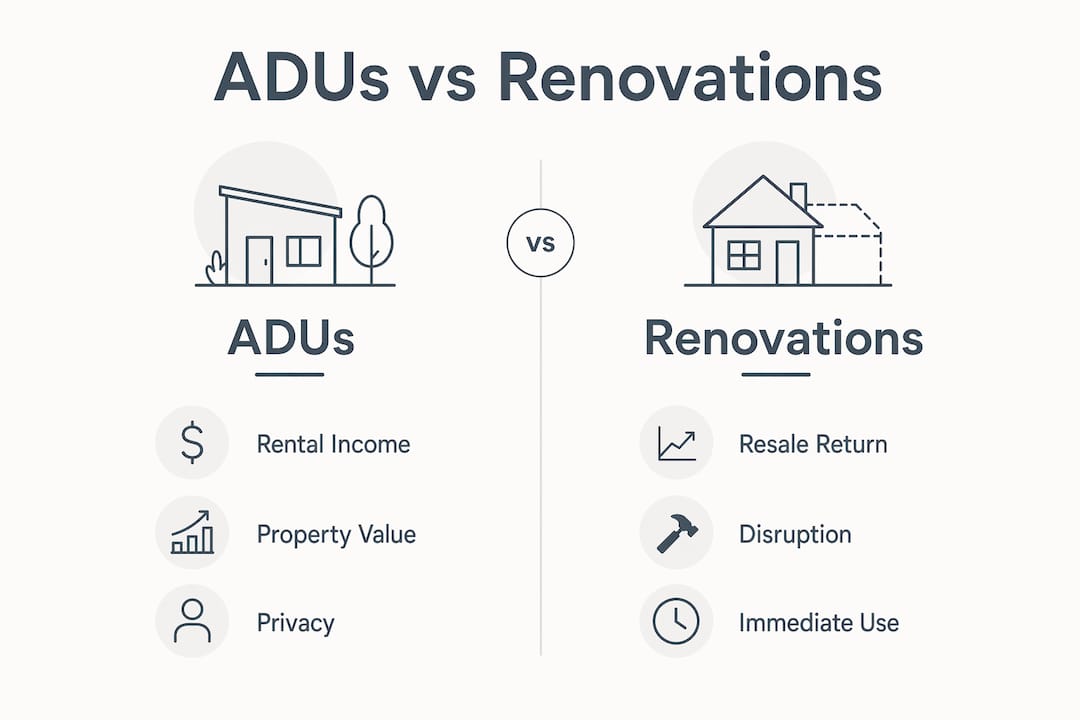
AARP data shows 1 in 4 homeowners over 50 have considered an ADU specifically for aging in place. That number reflects a real shift in how American families think about housing. People want to stay close to family without giving up independence, and a room addition cannot deliver that.
The benefits of ADU living for families extend beyond aging parents. Adult children returning home, live-in caregivers, and long-term guests all benefit from a self-contained space. A traditional renovation forces everyone into the same floor plan.
ADUs also drive faster sales. Homes with permitted ADUs sell 15–26% faster than comparable properties. Buyers recognize the income potential and flexibility, and they pay for it. A renovated bedroom does not create that kind of buyer demand.
Who benefits most from an ADU
- Aging parents who need proximity but not shared living space
- Adult children who want independence while reducing housing costs
- Live-in caregivers who need a private, functional home base
- Homeowners who want rental income without buying a second property
- Real estate investors adding cash flow to an existing lot
Environmental and neighborhood advantages of ADUs
ADUs carry a smaller environmental footprint than new construction or large additions. New ADUs are 44% smaller per capita than conventional single-family rentals. That smaller footprint means less material use, lower energy consumption, and reduced strain on local infrastructure.
Traditional room additions expand the primary structure, often requiring new rooflines, extended foundations, and upgraded HVAC systems. Each of those changes adds cost and environmental impact. An ADU built as a detached unit uses existing lot infrastructure and avoids many of those cascading upgrades.
Neighborhood concerns about ADUs are largely unfounded. Units are typically designed to match existing home aesthetics, and fears about neighborhood character impacts rarely materialize. Property values on the block tend to rise, not fall, when a well-built ADU is added.
“ADUs designed to align with neighborhood aesthetics reduce opposition and increase community acceptance, while simultaneously raising surrounding property values. The evidence consistently shows that permitted ADUs are a net positive for neighborhoods, not a disruption.”
Regulatory momentum supports this shift. Permitting reforms since 2025 have reduced processing times and removed barriers in many U.S. jurisdictions. Cities and counties are actively making ADUs easier to build, not harder.
Common concerns about ADUs and their real-world context
Upfront cost is the most common objection to ADUs. Build costs vary widely by type and location, but the financial returns outlined above put that cost in context. A detached ADU is an investment with measurable payback. A renovation is an expense with uncertain resale recovery.
Zoning and HOA restrictions are real but navigable. Many homeowners assume their lot cannot support an ADU without checking current rules. Post-2025 regulatory reforms have opened up ADU eligibility in hundreds of jurisdictions. Checking with your local planning department before ruling out an ADU is the right first step.
Construction disruption is another concern, but ADUs compare favorably here too. Traditional room additions require opening walls, rerouting utilities, and living through months of active construction inside your home. The renovation dependency chain means small delays cascade into large ones. A detached ADU is built separately, so your daily life is far less affected.
- Cost concern: ADU build costs are offset by rental income and equity gains that renovations cannot match.
- Zoning concern: Post-2025 reforms have expanded ADU eligibility significantly across the U.S.
- Disruption concern: Detached ADU construction does not require opening your primary home.
- Resale concern: Permitted ADUs improve resale outcomes and attract more buyers than most renovations.
Pro Tip: Consult your local planning department before finalizing any ADU or renovation plan. Zoning rules change frequently, and a 30-minute call can save months of wasted planning.
How to decide between an ADU and a traditional renovation
The right choice depends on your goals, not a universal rule. Immediate lifestyle benefits favor room additions, while long-term wealth building favors detached ADUs. Knowing which outcome matters more to you is the starting point.
Homeowners choosing between maximizing equity versus maximizing ROI on dollars spent face a real trade-off. Detached ADUs deliver the highest equity gains. Garage conversions and junior ADUs (JADUs) often deliver the best ROI on construction cost. Both outperform traditional renovations on income generation.
Use this framework to guide your decision:
| Decision factor | Favor an ADU | Favor a renovation |
|---|---|---|
| Financial goal | Rental income + equity growth | Improved personal use of space |
| Lot size | Sufficient for detached or attached unit | Limited, no room for separate structure |
| Timeline | 6–12 months acceptable | Need changes within 3–4 months |
| Disruption tolerance | Prefer separate construction | Comfortable with in-home work |
| Long-term plan | Hold property, build wealth | Sell within 2–3 years |
For investors, the multifamily ADU development benefits extend beyond a single unit. Adding an ADU to a rental property creates a second income stream on the same lot, which no renovation can replicate. For homeowners, the ADU vs. house addition comparison often resolves quickly once income potential is factored in.
Key Takeaways
ADUs outperform traditional renovations because they generate rental income, add measurable equity, and sell faster, while renovations recoup only a fraction of their cost with no income during ownership.
| Point | Details |
|---|---|
| ADUs generate income | Rental income of $1,800–$3,800/month starts from day one, unlike renovations. |
| Higher resale value | Permitted ADUs add $250,000–$400,000+ in property value, often exceeding build cost. |
| Faster property sales | Homes with ADUs sell 15–26% faster than comparable properties without them. |
| Better family flexibility | Separate kitchens and entrances support aging parents and adult children with real privacy. |
| Smaller environmental footprint | ADUs are 44% smaller per capita than conventional rentals, reducing resource use. |
Why I think most homeowners underestimate ADUs
I’ve watched homeowners spend $80,000 on a kitchen remodel and walk away with a nicer kitchen and maybe $40,000 in added value. Then I’ve seen a neighbor add a detached ADU, rent it out for $2,400 a month, and sell the property two years later for $350,000 more than the house next door. The math is not subtle.
The misconception I hear most often is that ADUs are complicated. People assume zoning will block them, that construction will be disruptive, or that tenants are a headache. All of those concerns are real in specific cases, but they are manageable. Regulatory reform has made permitting far more accessible than it was five years ago. Detached builds keep construction out of your living space. And professional property management handles tenant logistics for a modest fee.
What I find most interesting in 2026 is the shift in buyer behavior. Buyers are actively seeking properties with permitted ADUs because they see the income potential immediately. That demand is not going away. If anything, housing supply constraints will push it higher. An ADU is not just a financial asset. It is a property feature that makes your home more desirable to a growing pool of buyers.
My honest advice: if your lot can support an ADU and your timeline allows for it, the renovation conversation should start there, not end there. Run the numbers over a ten-year horizon. The ADU wins almost every time.
— Rudy
Live Large™ can help you build the right ADU
Deciding between an ADU and a traditional renovation is easier when you have the right guidance from the start. Live Large™ specializes in the purchase, financing, development, construction, and installation of accessory dwelling units and small-footprint modern homes across the U.S.
If you are in Florida, recent policy changes have made ADU development more accessible than ever. Tampa’s ADU policy reforms and expanded permitting in surrounding counties have opened real opportunities for homeowners who previously assumed ADUs were out of reach. Live Large™ tracks these regulatory shifts and helps homeowners act on them before the window closes. Whether you are exploring your first ADU or adding to an existing portfolio, the Live Large™ team brings the expertise to move your project from concept to completed unit.
FAQ
What is an ADU and how does it differ from a room addition?
An ADU is a fully self-contained secondary dwelling with its own kitchen, bathroom, and entrance on the same lot as a primary home. A room addition expands the existing structure but shares utilities and access with the main house.
How much value does an ADU add to a property?
A permitted, code-compliant ADU typically adds $250,000 to $400,000+ to resale value in many U.S. markets, often exceeding the total cost of construction.
Do ADUs really sell faster than homes without them?
Homes with permitted ADUs sell 15–26% faster than comparable properties, driven by buyer demand for flexible housing and income potential.
Is ADU construction more disruptive than a home renovation?
Detached ADU construction takes place outside the primary home, which means significantly less daily disruption than a traditional room addition that requires opening walls and rerouting utilities inside your living space.
Who should choose an ADU over a traditional renovation?
Homeowners and investors focused on long-term wealth building, rental income, or multigenerational living get more value from an ADU. A traditional renovation suits those who need immediate usability improvements and plan to sell within a few years.