
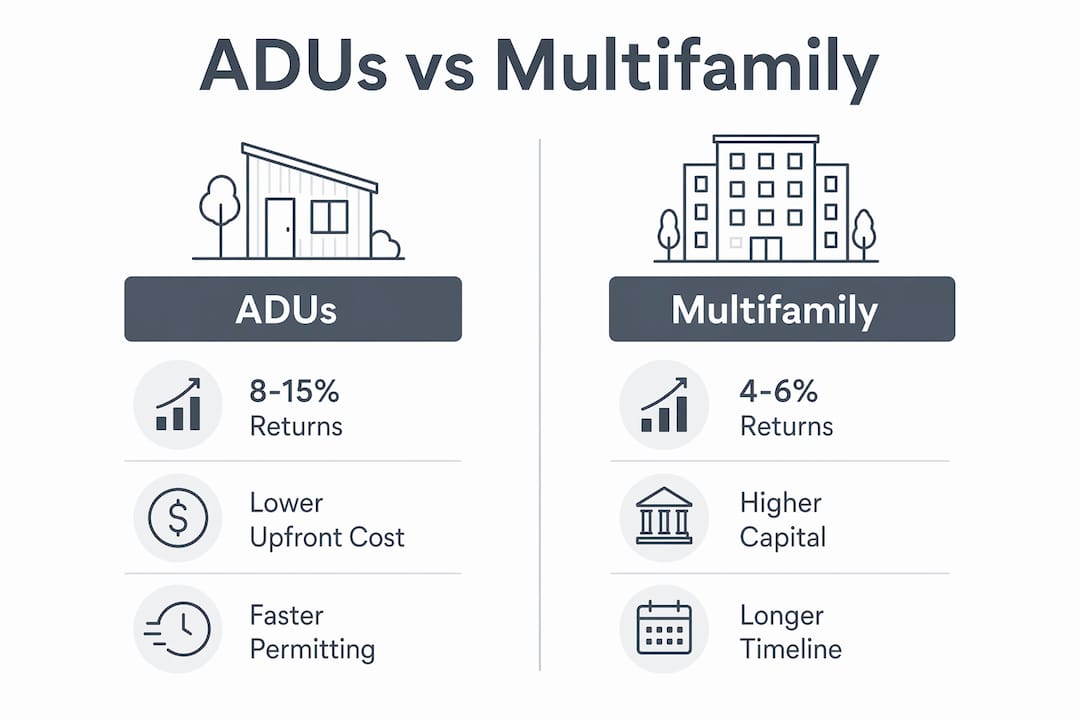
Accessory dwelling units (ADUs) are defined as secondary residential structures built on a single-family property, and they consistently outperform large multifamily properties on returns, operating costs, and financing speed. Why ADUs outperform large multifamily comes down to three structural advantages: higher unlevered yields, lower overhead, and faster capital deployment. Homeowners who build an ADU on existing land can generate unlevered returns of 8–15%, roughly double what traditional rental properties produce. That performance gap is not a market anomaly. It reflects the fundamental cost and regulatory advantages baked into ADU development.
Why ADUs outperform large multifamily on financial returns
The numbers favor ADUs at every stage of the investment cycle. Construction typically adds $150,000–$300,000 in immediate property value, increasing the home’s total appraised value by 30–35%. That is equity creation from day one, before a single rent check arrives.
Homes with ADUs appraise at an average of $1,064,000 compared to $715,000 for comparable homes without one. That 40–60% value premium reflects what the market already understands: an income-producing unit on the same parcel is worth significantly more than raw square footage. ADU rents run $2,000–$4,000 per month in most major markets, and property values grow at 9.34% annually for ADU-equipped homes.

Large multifamily acquisitions require far more capital upfront, carry higher cap rate compression risk, and depend on sustained occupancy across dozens of units to hit target returns. A single ADU on an existing lot sidesteps all of that. The 2026 ROI breakdown for ADUs shows that leveraged returns climb even higher when homeowners use existing equity rather than new debt.
| Metric | ADU | Large Multifamily |
|---|---|---|
| Unlevered return | 8–15% | 4–6% typical cap rate |
| Upfront capital required | $150,000–$300,000 (construction) | $1M+ acquisition cost |
| Property value uplift | 30–35% immediate | Depends on market timing |
| Monthly rent range | $2,000–$4,000 | Varies by unit mix |
| Permitting timeline | 60–90 days | 2–5 years |
What operational efficiencies give ADUs an edge?
ADUs run on existing infrastructure. Water, sewer, electrical, and gas connections already serve the primary home, so the incremental cost of adding a second unit is far lower than building a standalone rental property. That 44% smaller per capita footprint versus standard new rentals translates directly into lower utility costs, lower insurance premiums, and less landscaping overhead.
Managing one ADU on your own property is also fundamentally different from managing a 50-unit apartment building. There is no property management company taking 8–10% of gross rents. Lease terms are flexible. Tenant turnover affects one unit, not an entire building’s cash flow. The operational benefits for investors compound over time because the cost base stays low while rents rise.
Key operational advantages include:
- Shared infrastructure: No new utility hookups or road access required
- Lower insurance costs: Single-property policy covers both structures
- Simplified maintenance: One lot, one landscaping contract, one roof schedule
- Flexible leasing: Month-to-month or annual terms without commercial lease complexity
- Reduced vacancy risk: One vacant unit does not collapse total income
Pro Tip: Set up a dedicated bank account for ADU rental income from day one. Separating income and expenses makes tax filing cleaner and gives you a real-time view of your actual yield.
How does ADU financing compare to multifamily acquisition?
Multifamily development faces a structural bottleneck that ADUs simply do not. There are currently 750,000 entitled but stalled multifamily units sitting in the development pipeline across the country. These projects are fully approved but frozen because construction financing dried up, interest rates shifted, or lender requirements changed mid-project. That shadow pipeline represents years of delayed returns for investors who committed capital early.
ADUs bypass this entirely. Homeowners use existing equity through HELOCs or cash-out refinancing to fund construction. Programs like CalHFA offer up to $40,000 in predevelopment grants for qualifying ADU owners, reducing the cash required to break ground. Institutional investors, including family offices and small REITs, now partner with homeowners to fund ADU construction in exchange for a share of rental income, creating a capital path that requires no traditional bank financing at all.
The tax picture also favors ADUs. The IRS treats the full construction cost as a depreciable improvement over 27.5 years. On a $310,000 build, that produces roughly $11,300 in annual depreciation. That deduction often wipes out the rental income tax liability entirely for the first decade. Large multifamily acquisitions spread depreciation across a much larger cost basis, diluting the per-unit benefit.
Barriers in multifamily versus advantages in ADU development:
- Multifamily financing gaps: Construction loans require 60–70% LTV, extensive underwriting, and rate lock periods that often expire before permits clear
- Multifamily approval timelines: Full entitlement and permitting can take 2–5 years in most major metros
- ADU ministerial permitting: Many states now require 60–90 day permit approvals for ADUs by law, removing discretionary delays
- ADU equity financing: Homeowners tap existing home equity without new acquisition debt
- ADU tax concentration: Depreciation on a single improvement delivers outsized tax relief in early years
Pro Tip: Before applying for a HELOC to fund ADU construction, get a formal appraisal that includes the projected ADU value. Many lenders will underwrite against the post-construction value, giving you access to more capital at a lower rate.
How do ADUs create flexibility and portfolio value?
ADUs serve multiple purposes that large multifamily properties simply cannot. A single unit can function as a long-term rental, a short-term rental, a home office, a guest suite, or housing for an aging parent. That flexibility of use means the investment adapts to your life circumstances rather than locking you into a fixed income strategy.
For investors building a portfolio, ADUs offer incremental growth without the concentration risk of a large multifamily acquisition. Buying a 40-unit apartment building puts all your capital, all your debt, and all your operational risk into one asset. Adding ADUs across multiple single-family properties spreads that risk across different neighborhoods, tenant profiles, and local markets. The diversification benefits of small residential units are well documented for 2026 market conditions.
Policy trends reinforce this advantage. ADU permit volumes in Los Angeles County alone grew to over 45,000 by 2023, driven by state-level reforms that removed local barriers. Florida, Texas, and other high-growth states are following with similar legislation. That regulatory tailwind reduces future permitting risk for investors who act now.
ADU use cases that add portfolio value:
- Multigenerational housing: House a family member while generating imputed savings on care costs
- Rental income: Collect $2,000–$4,000 per month with no property management fee
- Short-term rental: Convert to vacation rental in high-demand markets for premium nightly rates
- Home office: Deduct a dedicated workspace from business income
- Resale premium: Buyers pay more for properties with existing ADU income already in place
Key Takeaways
ADUs outperform large multifamily properties because they deliver higher yields, lower operating costs, faster permitting, and tax advantages that multifamily acquisitions cannot match at the same capital scale.
| Point | Details |
|---|---|
| Superior unlevered returns | ADUs generate 8–15% unlevered returns, roughly double typical multifamily cap rates. |
| Immediate property value gain | Construction adds 30–35% to home value, creating equity before rental income begins. |
| Faster financing and permitting | Ministerial ADU permits close in 60–90 days versus 2–5 years for multifamily projects. |
| Concentrated tax depreciation | A $310,000 ADU build produces ~$11,300 annual depreciation, often eliminating rental tax liability for a decade. |
| Built-in use flexibility | ADUs serve as rentals, family housing, offices, or guest suites, adapting to changing needs. |
The case for ADUs is stronger than most investors realize
I have watched homeowners dismiss ADUs as a “small play” while chasing multifamily deals that took three years to close and delivered mediocre returns. That framing is backwards. The scale of a multifamily acquisition is not a feature. It is a liability when financing markets tighten, when permitting stalls, or when one large tenant defaults and takes 10% of your income with them.
What I find most compelling about ADUs is the control they give you. You are not dependent on a syndicator, a construction lender, or a city planning board that meets twice a month. You own the land. You tap your own equity. You build on a timeline that a ministerial permit process protects by law in most states. That is a structural advantage that no amount of multifamily deal flow can replicate.
The investors I respect most in this space are not the ones chasing the biggest deals. They are the ones quietly adding one ADU per year to their existing properties, compounding equity and rental income with almost no additional overhead. The passive income potential of that approach is genuinely underappreciated by the broader market.
— Rudy
Live Large™ helps you build ADUs that perform
Live Large™ specializes in the purchase, financing, development, construction, and installation of ADUs and small footprint modern homes. If you are a homeowner or investor ready to put the advantages covered here into practice, Live Large™ has the expertise to move your project from concept to completed unit.
Local policy reforms are creating real opportunities right now. Tampa’s ADU policy reforms and Pasco County’s ADU approvals have opened the door for homeowners across the region to build faster and with less regulatory friction than ever before. Live Large™ works directly in these markets and understands the local permitting landscape in detail. Connect with the Live Large™ team to find out what your property qualifies for and what your ADU could realistically earn.
FAQ
What returns can an ADU generate compared to multifamily?
ADUs generate unlevered returns of 8–15%, roughly double the 4–6% cap rates typical of large multifamily acquisitions. Construction also adds $150,000–$300,000 in immediate property value.
How long does it take to permit an ADU versus a multifamily project?
Most states now require ministerial ADU permit approvals within 60–90 days. Large multifamily projects typically take 2–5 years to clear full entitlement and permitting.
What tax advantages do ADUs offer investors?
The IRS allows the full ADU construction cost to be depreciated over 27.5 years. On a $310,000 build, that produces approximately $11,300 in annual depreciation, which often eliminates rental income tax liability for the first decade.
Can homeowners use existing equity to finance an ADU?
Yes. HELOCs, cash-out refinancing, and programs like CalHFA grants of up to $40,000 make ADU construction accessible without new acquisition debt. Institutional investors also partner with homeowners to co-fund construction in exchange for a share of rental income.
Do ADUs increase resale value?
Homes with ADUs appraise at an average of $1,064,000 versus $715,000 for comparable homes without one, and ADU-equipped properties appreciate at 9.34% annually, outpacing the broader single-family market.