
An accessory dwelling unit (ADU) is a self-contained secondary home on the same lot as a primary residence, equipped with full independent living facilities, and legally permitted for rental use. The term “ADU for rental” describes this unit specifically in its role as an income-generating property. Legal definitions require permanent cooking, sleeping, and sanitation facilities, not just livable square footage. Common forms include basement apartments, detached backyard cottages, garage conversions, and in-law suites. For homeowners in the U.S., an ADU represents one of the most accessible paths to rental income without purchasing a separate investment property.
What is an ADU for rental, and what does the law require?
An ADU is legally defined as an attached or detached residential unit that provides complete independent living facilities on the same lot as a primary dwelling. The Los Angeles Municipal Code Section 12.03 is one of the most cited legal benchmarks in the U.S. It requires provisions for living, sleeping, eating, cooking, and sanitation. A unit missing any of these elements does not qualify as an ADU under most local codes.
Zoning rules shape what you can build and where. Most jurisdictions regulate ADU size relative to the primary home, require owner occupancy of at least one unit in some cases, and restrict the number of ADUs per lot. Local codes also govern setbacks, height limits, and parking requirements. These rules directly affect whether your unit qualifies for legal rental use.

The distinction between an ADU and a Junior ADU (JADU) matters for landlords. A JADU is typically carved out of existing home space, capped at 500 square feet, and may share a bathroom with the main house. A standard ADU must be fully independent. Units lacking permanent cooking or sanitation facilities often fail to meet the legal threshold for rental qualification.
Pro Tip: Before you spend a dollar on construction, pull your local zoning code and confirm your parcel is eligible. Many cities now publish ADU eligibility maps online, which saves weeks of back-and-forth with the planning department.
Key legal criteria to verify before renting:
- Permanent kitchen with cooking appliances
- Dedicated bathroom with toilet and shower or tub
- Separate sleeping area
- Independent entrance (required in most jurisdictions)
- Valid building permit and certificate of occupancy
- Compliance with local size and setback rules
States like Florida are actively expanding ADU access. Florida lawmakers have proposed broader ADU allowances, including mother-in-law suites, as a direct response to the affordable housing shortage. Tampa and Pasco County have both updated local ordinances to reflect this shift, with Tampa’s ADU policy reforms making it easier for homeowners to build and rent secondary units.
How to rent an ADU: setup, leasing, and management
Renting an ADU requires the same landlord responsibilities as any residential rental property. You set rent, screen tenants, draft a lease, collect payments, and maintain the unit. The difference is proximity. You may live 30 feet from your tenant, which makes tenant selection and clear lease terms more critical than in a typical landlord-tenant relationship.
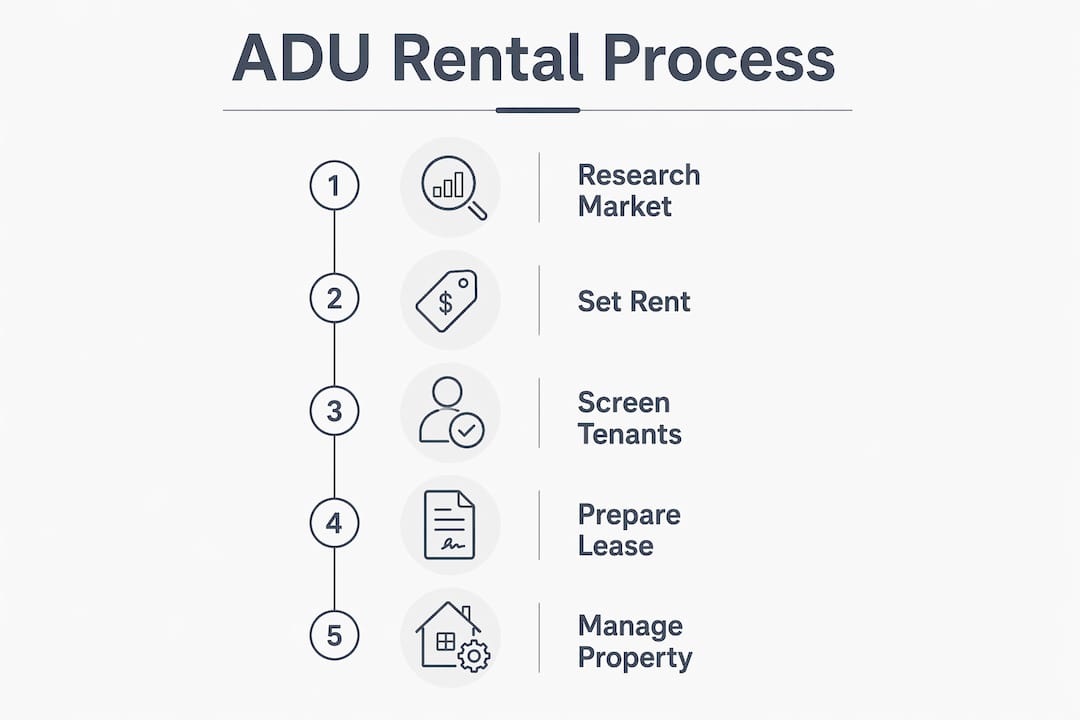
Setting competitive rent starts with local market research. Check comparable rentals in your neighborhood on platforms like Zillow or Apartments.com. Factor in the ADU’s size, amenities, and whether utilities are included. Underpricing leaves money on the table. Overpricing extends vacancy periods, which costs more than a modest rent reduction.
Drafting a clear lease is the single most important step in managing an accessory dwelling unit rental. Your lease should specify rent amount, due date, late fees, security deposit terms, occupancy limits, pet policy, and maintenance responsibilities. Freddie Mac’s homeownership resources identify detailed lease agreements as a primary factor in reducing landlord-tenant disputes.
Pro Tip: Add a noise and quiet-hours clause to your ADU lease. Because you share a property, disputes over noise are the most common friction point between ADU landlords and tenants. Addressing it upfront prevents most problems.
- Research local rental comps before setting your price
- Draft a lease that covers rent, deposits, late fees, and occupancy rules
- Screen tenants with a credit check, background check, and rental history verification
- Establish a maintenance request process in writing from day one
- Clarify shared spaces, such as driveways or yards, in the lease
- Inspect the unit at move-in and move-out with documented photos
Property management for an ADU is simpler than managing a remote rental. You are on-site, which speeds up maintenance response and reduces vacancy. The tradeoff is that tenant conflicts feel more personal. Some homeowners hire a local property manager to create professional distance, which costs roughly 8–12% of monthly rent but removes the emotional friction of being a neighbor-landlord.
What are the tax and financial benefits of an ADU rental?
ADU rental income is taxable, but the IRS provides depreciation deductions that reduce your net tax burden. Rental property depreciation follows a 27.5-year straight-line recovery period applied only to the building portion of the property. Land value is excluded from depreciation calculations entirely. This means you need an accurate land-to-building value split, typically from your property tax assessment, before calculating your annual deduction.
The mid-month convention affects your first year of depreciation. The IRS requires you to treat the property as placed in service at the midpoint of the month you first rent it, regardless of the actual date. That reduces your first-year deduction. Depreciation timing is especially relevant for landlords who complete construction late in the calendar year and expect a full-year deduction.
ADUs differ from standalone investment properties in how lenders treat them. ADUs are regulated as subordinate units that cannot be sold separately from the primary home. This limits your financing options compared to a duplex or condo. Lenders assess ADU rental income differently, and some conventional loan programs require documented rental history before counting ADU income toward qualification.
| Financial Factor | ADU Rental | Separate Investment Property |
|---|---|---|
| Depreciation period | 27.5 years (building only) | 27.5 years (building only) |
| Land excluded from depreciation | Yes | Yes |
| Sold independently | No | Yes |
| Rental income counted by lenders | Varies by program | Standard underwriting |
| Entry cost | Lower (existing lot) | Higher (separate purchase) |
Using a HELOC payment calculator helps homeowners model financing costs before committing to ADU construction. Many homeowners fund ADU builds through a home equity line of credit, which ties repayment to the rental income the unit generates.
Which ADU type generates the best rental income?
ADU types fall into four main categories: attached additions, detached backyard units, basement conversions, and garage conversions. Each carries different construction costs, tenant appeal, and rental income potential.
Detached ADUs command the highest rents because they offer the most privacy and independence. A tenant in a detached backyard unit has no shared walls, a separate entrance, and often a private yard area. That privacy premium translates directly into higher monthly rent. Construction costs are also highest for detached units, which affects your payback period.
Basement apartments are the most affordable to build because the structure already exists. The tradeoff is limited natural light and lower ceiling heights, which reduce tenant appeal in competitive rental markets. Garage conversions sit in the middle: moderate construction cost, good privacy, and strong demand in urban and suburban markets where parking is less critical.
Attached ADUs share a wall with the primary home. They cost less than detached units and are faster to permit in many jurisdictions. Tenants accept slightly less privacy in exchange for lower rent. For homeowners who want to house a family member rather than a stranger, attached units work well.
- Detached backyard unit: Highest rent, highest build cost, best tenant privacy
- Garage conversion: Moderate cost, strong urban demand, good independence
- Basement apartment: Lowest build cost, lower rent ceiling, limited light
- Attached addition: Shared wall, faster permitting, suits family use
The accessory dwelling unit rental market has grown significantly as housing costs rise in major U.S. metros. Homeowners in cities like Los Angeles, Seattle, and Austin report that well-built detached ADUs generate enough monthly income to cover a meaningful portion of their mortgage payment.
Key Takeaways
An ADU for rental is a legally compliant, fully equipped secondary unit that generates income while staying on the same lot as your primary home.
| Point | Details |
|---|---|
| Legal compliance is non-negotiable | A unit must have permanent cooking, sleeping, and sanitation facilities to qualify as a rentable ADU. |
| Lease quality determines success | Clear terms on rent, deposits, occupancy, and maintenance reduce disputes and protect your income. |
| Depreciation reduces tax burden | IRS rules allow 27.5-year straight-line depreciation on the building portion, not the land. |
| ADUs cannot be sold separately | This limits financing options compared to standalone investment properties like duplexes. |
| Detached units earn the most | Detached ADUs command higher rents due to privacy, though they carry higher construction costs. |
Why most homeowners underestimate what it takes to rent an ADU
I’ve seen homeowners build beautiful ADUs and then stumble badly at the rental stage. The construction gets all the attention. The landlord work gets none. That imbalance is where most problems start.
The biggest mistake I see is skipping the legal compliance check. A unit that looks like an apartment is not legally an ADU until it has a valid permit and certificate of occupancy. Renting an unpermitted unit exposes you to fines, forced vacancy, and loan complications if you ever refinance. Verify compliance first, every time.
Tenant screening is the second area where new landlord-homeowners cut corners. Because the tenant lives on your property, a bad fit affects your daily life, not just your bank account. Run a full credit and background check. Call previous landlords. The extra week of vacancy is worth it.
The financial planning piece surprises most people. Depreciation deductions are real money, but only if you calculate them correctly and time them well. I recommend working with a CPA who has rental property experience in your state, not a generalist who handles W-2 returns. The difference in tax strategy is significant.
Finally, do not underestimate the value of professional property management, even for a single ADU. The cost is modest relative to the stress it removes. If you want the income without the friction of being a neighbor-landlord, a local property manager is worth every dollar.
— Rudy
Livelarge helps homeowners build and rent ADUs with confidence
Livelarge specializes in the purchase, financing, development, construction, and installation of accessory dwelling units and small-footprint modern homes. If you are a homeowner ready to turn your backyard into a passive income source, Livelarge provides the expertise to get your ADU built, permitted, and rental-ready.
Homeowners in Florida have a particularly strong window right now. Pasco County’s ADU approvals and ongoing state-level policy changes are opening new opportunities for rental income that did not exist a few years ago. Livelarge tracks these regulatory shifts and helps homeowners act on them before local markets get crowded. Whether you are evaluating your first ADU or planning a second unit, Livelarge connects you with the right tools, financing options, and construction partners to make it work.
FAQ
What qualifies a unit as a legal ADU for rental?
A unit qualifies as a legal ADU when it includes permanent cooking, sleeping, and sanitation facilities, holds a valid building permit, and complies with local zoning rules. Units missing any of these elements do not meet the legal threshold for rental use in most U.S. jurisdictions.
Can I rent out an ADU and live in the main house?
Yes. Most ADU regulations are designed specifically for this arrangement, where the homeowner occupies the primary residence and rents the secondary unit. Some jurisdictions require owner occupancy of at least one unit on the lot as a condition of the ADU permit.
How does ADU rental income affect my taxes?
ADU rental income is taxable, but you can deduct expenses including mortgage interest, repairs, and depreciation. The IRS applies a 27.5-year depreciation schedule to the building portion of the property, which reduces your taxable rental income each year.
What is the difference between an ADU and a JADU?
A JADU (Junior ADU) is a smaller unit, typically under 500 square feet, carved from existing home space and sometimes sharing a bathroom with the main house. A standard ADU is fully independent with its own entrance, kitchen, and bathroom, and generally commands higher rent.
Can an ADU be sold separately from the main home?
No. ADUs are legally subordinate to the primary dwelling and cannot be sold separately. This is a key difference from a duplex or condo conversion, and it affects how lenders underwrite ADU rental income during mortgage qualification.