
The most profitable small home development exit options in 2026 are traditional resale, rent-to-own, vacation rental conversion, seller financing, and strategic community partnerships. Each path carries a different risk profile, management burden, and regulatory footprint. Here is what separates the developers who exit cleanly from those who get stuck holding an asset they cannot move.
The five core exit paths at a glance:
- Traditional resale: Fastest exit when timed to spring markets; works best with permanent foundations on owned land
- Rent-to-own: Generates 7–12% higher sale prices than straight sales, with a 2–5% non-refundable option fee upfront
- Vacation rental conversion: Short-term platforms like Airbnb work well near parks or recreation areas; management intensity is high
- Seller financing: Can boost sale prices 10–15% and create passive income, but requires promissory notes and security agreements
- Strategic partnerships: Tiny home communities like those modeled after Kasita micro-homes or Getaway maintain buyer waitlists that can cut your sales timeline from months to weeks
Real-world projects illustrate the range. The Llano Exit Strategy in Texas demonstrated how a cluster of small cabins on owned land could be repositioned as a short-term rental portfolio before a clean sale. Kasita micro-homes built modular units designed for community deployment, making bulk acquisition by operators a viable exit. Getaway and Woody tiny homes showed that vacation rental income can sustain a project while the developer waits for the right buyer. Rural Studio, the Auburn University design-build program, proved that mission-driven small home development can attract institutional buyers and nonprofit acquirers as exit partners.
What financing models work for small home development exits?
The financing structure you choose at acquisition shapes every exit option you will have later. Get this wrong and you narrow your buyer pool before you even list.
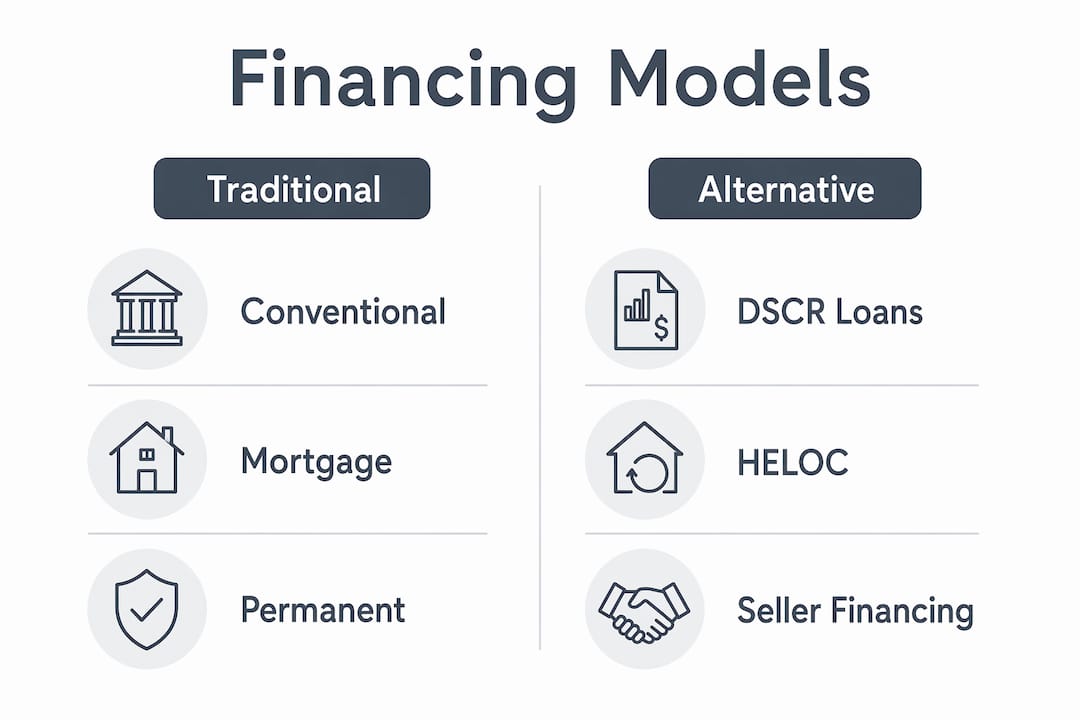
Conventional mortgages apply when a modular home sits on a permanent foundation. Rates in 2026 run 7–8.5% on investment property, with 20–25% down. The catch is loan size: many lenders will not originate below $100,000 because the economics do not justify the paperwork.

DSCR loans solve that problem for rental-focused projects. These investor loans qualify the property on projected rental cash flow rather than your personal income. DSCR loans start at $55,000 with rates of 7.5–9.5% in 2026, higher than conventional but with faster approval and looser income documentation. For a developer planning a vacation rental exit, DSCR financing is often the cleaner path.
HELOC financing on a primary residence is a common bridge move. Investors with equity in a primary home can draw a line at primary-residence rates and use it to fund a tiny home acquisition, avoiding investment-property underwriting entirely.
Seller financing functions as both a funding tool and an exit mechanism. Seller financing expands your buyer pool when traditional lenders will not touch a deal, but it requires thorough legal review. Promissory notes, security agreements, and in some cases a lien on the property protect the seller. Interest rates on seller-financed tiny home deals generally run 6–12% depending on buyer credentials. Seller financing arrangements can boost sale prices by 10–15% compared to conventional sales.
Pros and cons by financing type:
- Conventional mortgage: Lower rates, longer terms, but restrictive on loan size and property type
- DSCR loan: Flexible qualification, faster close, but higher rates and requires rental income documentation
- HELOC: Flexible deployment, primary-residence rates, but ties up equity in your main home
- Seller financing: Expands buyer pool and boosts sale price, but carries credit risk and legal complexity
Llano Exit Strategy and similar Texas cabin clusters leaned on HELOC and seller financing combinations to fund initial builds, then exited through seller-financed sales to buyers who could not qualify for conventional loans. Kasita’s modular approach attracted institutional capital, which is a different lane entirely but illustrates how financing structure at the development stage determines who can buy you out.
Which investment strategies generate the best returns on tiny home projects?

Long-term rental, short-term vacation rental, and rent-to-own each optimize for a different variable. Picking the wrong one for your location and management capacity is where most developers leave money on the table.
Short-term vacation rentals generate the highest gross income in the right location. A well-positioned tiny home near a national park or popular recreation area can produce two to three times the monthly income of a long-term rental. The trade-off is management intensity: self-managing a short-term rental typically requires 8–20 hours per month per unit. Property managers take 18–25% of net income, so the math only works if your nightly rate supports that haircut.
Getaway built an entire business model around this logic, placing small cabins within two hours of major cities and charging premium rates for the “disconnect” experience. Woody tiny homes took a similar approach in scenic markets. Both projects demonstrate that location specificity matters more than the home itself.
Mid-term leases (30 days to one year) are the approach seasoned operators use to balance management load against regulatory exposure. You avoid the permit headaches of short-term rentals while still commanding rates above long-term market rent. Traveling nurses, remote workers, and people “trying tiny” before buying are reliable tenant pools for this model.
Rent-to-own works particularly well when buyer demand is strong but financing availability is thin. The structure gives tenants a trial period, which overcomes the lifestyle uncertainty that kills many tiny home sales. Listings in tiny house-friendly jurisdictions sell up to three times faster and at 10–20% higher prices than comparable properties in restrictive markets.
Timing your exit matters. Tiny home listings attract 30–45% more inquiries in spring and early summer than in winter, and properties sell 30–45% faster during that window. If you are planning a traditional resale, listing in April or May is not optional strategy; it is basic math.
Pro Tip: If your sale timeline extends past expectations, convert to a short-term or mid-term rental to cover carrying costs. Platforms like Airbnb or VRBO can generate enough income in tourist-adjacent markets to offset holding costs entirely while you wait for the right buyer.
What legal and regulatory factors affect your exit plan?
Zoning is the single biggest external variable in tiny home exit planning. Get it right and your resale timeline shrinks dramatically. Get it wrong and you may be unable to rent, sell, or even legally occupy the unit.
Classification matters first. Tiny homes on wheels (THOWs) are legally personal property in most states, which limits traditional financing and thins your buyer pool. Permanent foundations convert the asset to real estate, unlocking conventional mortgage eligibility and improving resale liquidity. Misclassifying a THOW as real estate is a compliance error that can unwind a sale at closing.
ADU and overlay district policies are expanding in many markets. Municipalities that have adopted specific tiny house amendments, created overlay districts, or established accessory dwelling unit provisions create the strongest resale environments. Tampa’s ADU policy reforms are a live example of how local regulatory shifts can open or close exit doors quickly.
Short-term rental licensing adds another layer. Many cities now require STR permits, impose occupancy caps, or restrict rentals in residential zones. Mid-term leases often fall outside these restrictions, which is part of why experienced operators favor them.
Seller-financing agreements require attorney review. A promissory note without a properly recorded lien leaves the seller exposed if the buyer defaults. This is not a DIY document situation.
Key regulatory factors to track:
- Zoning classification (residential, ADU overlay, tiny house community designation)
- THOW versus permanent foundation legal status
- Short-term rental permit requirements and occupancy limits
- Seller financing documentation requirements by state
- HOA and deed restriction language that may prohibit rentals or resale to certain buyers
Pro Tip: Before acquiring land for a tiny home project, verify that the parcel has existing metered water, sewer, and electricity connections. Utility connection costs can exceed the cost of the home itself. One developer installing a septic system alone incurred a substantial expense before the first tenant moved in.
How should you manage portfolio risk in small home investing?
Small home investments carry liquidity and regulatory risks that traditional single-family properties do not. Treating them as a standalone portfolio category rather than a substitute for conventional real estate is the right frame.
Experienced investors limit tiny home and short-term rental allocation to a fractional share of their total real estate holdings. The category offers genuine upside, but the resale market is thin. Selling a tiny home installation typically takes 90–180 days versus 30–60 days for a comparable stick-built property. That liquidity gap has real consequences if you need to exit quickly.
The land question is the most important decision. Owned land plus a permanent-foundation modular unit operates as real estate. Anything else operates as personal property with thinner economics and tighter exits. Developers who install on leased land or skip the permanent foundation trade long-term flexibility for short-term cost savings, and most regret it.
Risk mitigation tactics that actually move the needle:
- Buy land outright and install on a permanent foundation to maximize financing options and resale marketability
- Research zoning and regulatory trajectory before acquisition, not after; tiny house-friendly jurisdictions can triple resale speed
- Diversify exit types across your portfolio (some units positioned for resale, others for rental income) to reduce dependence on any single market condition
- Avoid concentrating multiple units in a single jurisdiction where one regulatory change can affect all of them simultaneously
- Use portfolio diversification strategies to balance tiny home exposure against more liquid real estate holdings
For developers building a real estate business rather than a single project, the passive income potential of backyard ADUs offers a lower-risk entry point with stronger financing options and clearer regulatory paths than standalone tiny home projects.
What does a realistic exit timeline look like?
Exit timelines vary significantly by strategy, and most developers underestimate how long each phase actually takes.
Traditional resale (3–9 months total):
- Months 1–2: Market preparation, professional photography, pricing analysis using tools like AirDNA for comparable rental data
- Month 2–3: Listing, showings, offer negotiation
- Months 3–6: Buyer financing approval (longer if the buyer uses DSCR or seller financing)
- Month 6–9: Closing, title transfer, final inspections
Rent-to-own (12–36 months to full exit):
- Month 1: Structure agreement, collect 2–5% option fee, record contract
- Months 1–36: Collect monthly payments, a portion of which applies to the purchase price
- Month 12–36: Buyer exercises option and secures financing, or forfeits option fee and you restart
Vacation rental conversion with eventual sale (18–36 months):
- Months 1–3: STR permit acquisition, platform setup, furnishing and photography
- Months 3–18: Revenue generation, performance tracking, occupancy optimization
- Months 12–24: Market the property as a turnkey income-producing asset, which commands a premium over vacant land or an unfurnished unit
- Months 18–36: Sale to an operator buyer who values the existing booking history
Seller financing (7–15 years to full capital recovery):
- Month 1: Negotiate terms, attorney drafts promissory note and security agreement
- Months 1–180: Collect monthly principal and interest payments
- Year 5–15: Balloon payment or full amortization completes the exit
The right timeline depends on your capital position. Early-stage developers with one or two units need faster capital recycling, which favors traditional resale or short rent-to-own terms. Developers with multiple income-producing units can afford to hold seller-finance notes and let returns compound. Expanding your buyer pool through lead generation at each stage shortens timelines across every exit type.
Key Takeaways
Permanent foundations on owned land are the single most important structural decision for maximizing exit flexibility and financing options in small home development.
| Point | Details |
|---|---|
| Foundation determines financing | Permanent foundations convert tiny homes to real estate, unlocking conventional mortgages and improving resale liquidity. |
| Rent-to-own commands a premium | Rent-to-own arrangements close at higher prices than straight sales, with option fees collected upfront. |
| Seller financing boosts price but requires legal structure | Seller financing can increase sale prices by 10–15% but requires promissory notes, security agreements, and attorney review. |
| Spring listings sell faster | Tiny home listings attract significantly more inquiries and sell faster in spring and early summer compared to winter. |
| Utility costs can exceed home costs | Acquiring land with existing metered connections avoids infrastructure expenses that can exceed the cost of the home itself. |
Live Large™ specializes in the purchase, financing, development, construction, and installation of accessory dwelling units and small-footprint modern homes. If you are planning a development project and want to understand how ADU policy changes in your market affect your exit options, Live Large™ can help you build the right structure from the start.