
A short term rental ADU setup is the process of preparing an accessory dwelling unit to host paying guests legally, consistently, and profitably. Accessory dwelling units, commonly called ADUs, are secondary housing structures on a residential property. Done right, an STR ADU generates 30–80% higher gross monthly income than a traditional long-term lease. That gap narrows after expenses, but the income potential is real. What separates profitable operators from frustrated ones is preparation: understanding local regulations, investing in the right design features, and treating the unit as a hospitality business from day one.
What legal regulations affect short term rental ADUs in the U.S.?
Regulations are the single biggest variable in any ADU rental setup. The rules differ not just by state, but by city, county, and even neighborhood zoning district.
California’s 2025 law changes everything
California now prohibits STRs under 30 days for any ADU permitted on or after January 1, 2025. Los Angeles caps STR ADU nights at 120 per year. Sacramento requires a 30-day minimum lease for all ADUs. Only ADUs built before 2025 may qualify for exceptions, and even those face local caps and licensing requirements. If you are planning a new build in California, nightly rentals are effectively off the table.
Florida’s city-by-city patchwork
Florida has no single statewide STR rule for ADUs. Instead, each city sets its own minimum stay and licensing requirements. Miami allows short-term rentals with a Certificate of Use and an annual fee. Sarasota city permits 7-day minimum stays with a license. Orlando, Fort Lauderdale, and Clearwater ban rentals under 30 days entirely. Homeowners in Florida must research their specific city before furnishing a single room.
The permit vs. license distinction
One of the most costly mistakes in STR ADU planning is assuming a building permit covers everything. Zoning permits and STR business licenses are separate authorizations. Legal permission to build an ADU does not guarantee the right to list it on a short-term rental platform. Cities may impose night caps, owner-occupancy requirements, and registration rules that go beyond construction approvals. Always verify address-specific STR eligibility before spending money on furniture or marketing.
HOA and zoning overlays
Homeowners associations can prohibit STRs even when local government allows them. Zoning overlays in historic districts or coastal zones add another layer. The safest approach is to pull the zoning designation for your specific parcel, contact your city’s planning department directly, and review any HOA covenants before committing to an STR strategy.
| Jurisdiction | Minimum Stay | Key Requirement |
|---|---|---|
| California (post-2025 ADUs) | 30 days | State law; local caps apply |
| Los Angeles | 120 nights/year cap | STR permit required |
| Miami, FL | No minimum (city allows) | Certificate of Use + annual fee |
| Sarasota, FL | 7 days | STR license required |
| Orlando, FL | 30 days | Nightly STR effectively banned |
What design and hardware investments optimize ADUs for short term rental success?
The physical setup of your ADU determines your booking rate, your nightly price, and your guest reviews. Cutting corners on design costs you more in lost revenue than it saves in upfront spending.
Technology and access
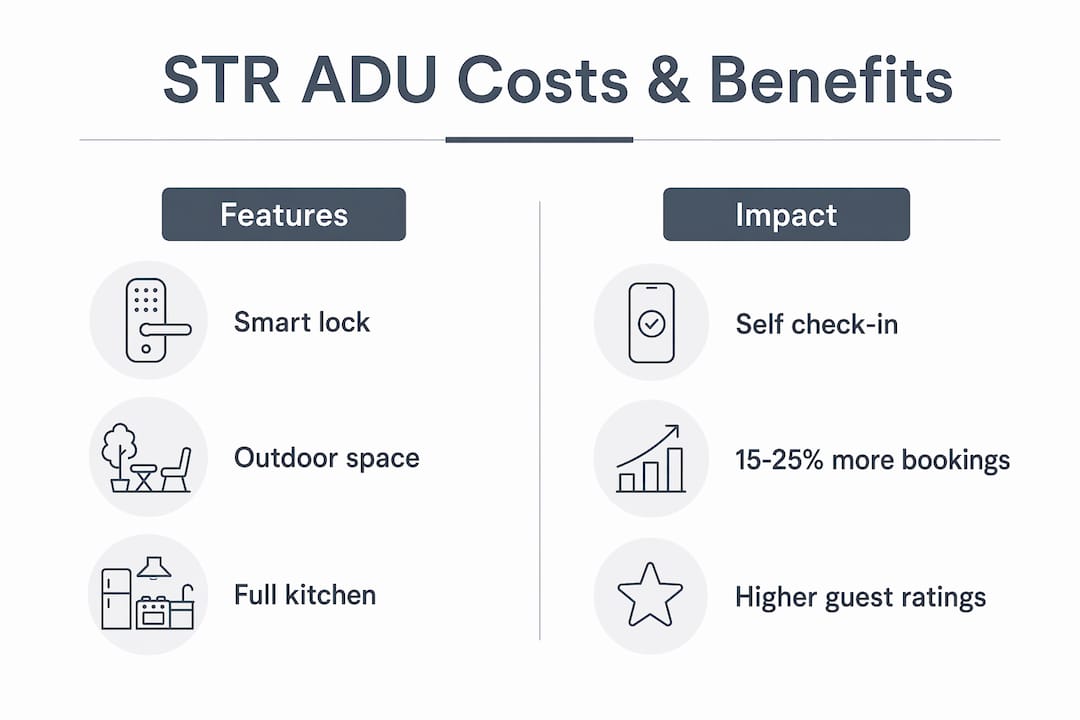
Smart locks are non-negotiable for STR operations. Smart locks cost $150–$400 and allow keyless, code-based entry that you can change between guests remotely. Dedicated high-speed internet runs $50–$100 per month and should be on a separate account from your primary residence. Guests rank reliable Wi-Fi among their top priorities, and a slow connection generates negative reviews fast.
Kitchen and laundry
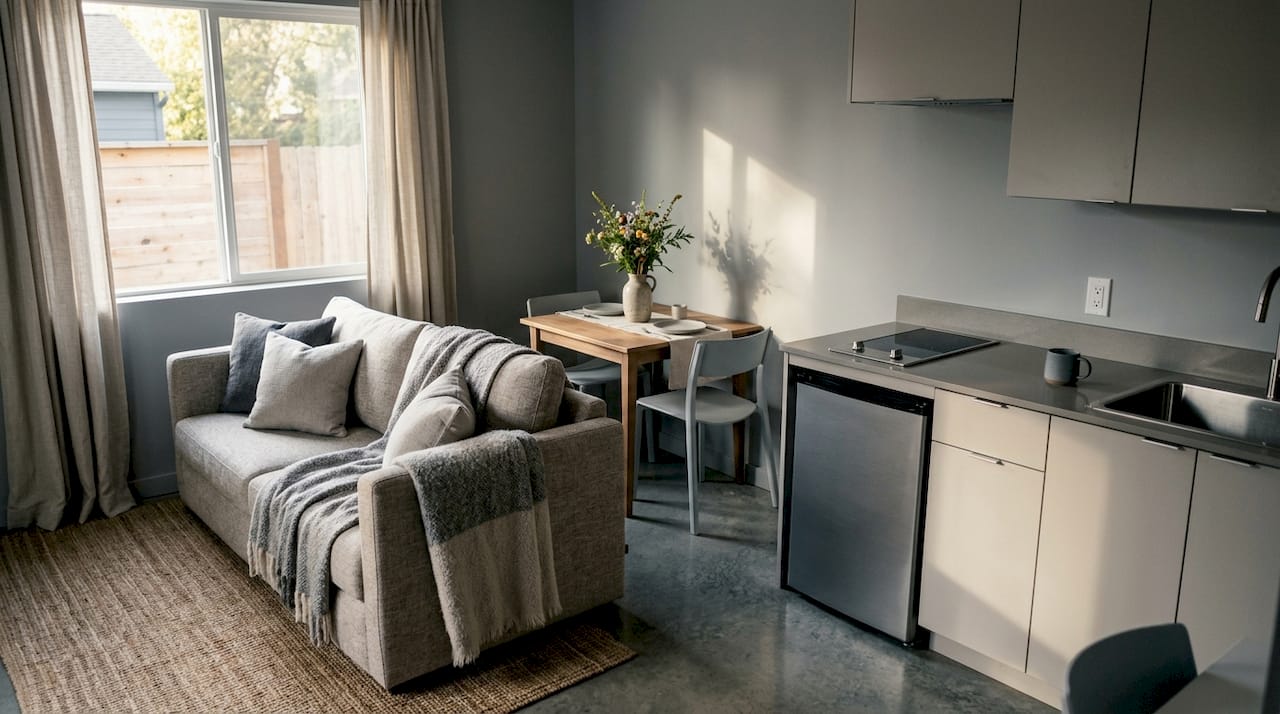
A full kitchen with a stove, oven, refrigerator, and dishwasher positions your ADU as a home, not a hotel room. That distinction justifies higher nightly rates and attracts longer stays. In-unit laundry is a competitive differentiator, particularly for stays of three or more nights. Guests staying a week or longer will pay a premium to avoid a laundromat.
Pro Tip: Invest in a stackable washer-dryer combo to preserve floor space in smaller ADUs while still offering the full-size amenity guests expect.
Outdoor space and layout
Private outdoor spaces increase booking rates by 15–25%. A small patio, deck, or fenced yard with seating costs relatively little to furnish but significantly raises your property’s appeal. For prefab ADU installations, plan for 12–14 feet of access width on your property and a 1–3 day installation window. Good interior design for small ADUs maximizes every square foot and directly affects how guests perceive value.
| Feature | Estimated Cost | Impact |
|---|---|---|
| Smart lock | $150–$400 | Enables self-check-in, reduces friction |
| Dedicated internet | $50–$100/month | Top guest priority, affects reviews |
| In-unit laundry | $800–$1,500 installed | Attracts longer stays, higher rates |
| Private outdoor space | $500–$2,000 furnished | Increases booking rate by 15–25% |
| Full kitchen setup | $1,500–$4,000 | Justifies premium pricing |
How to manage the operations of a short term rental ADU efficiently?
Running an STR ADU is a part-time job. Treating it as passive income leads to poor reviews, declining occupancy, and eventual burnout.
Time commitment and cleaning standards
STR hosting requires 10–20 hours per month for guest communication, cleaning coordination, and maintenance. That estimate assumes smooth operations. A single maintenance issue or difficult guest can double that number in a week. Cleaning turnovers cost $100–$150 each, and hotel-quality cleanliness is the baseline expectation, not a bonus. Guests who pay $150 per night expect spotless floors, fresh linens, and fully stocked supplies every single time.
The real cost of operating
Hidden costs consume 40–60% of gross revenue. Platform fees, cleaning, utilities, toiletries, and periodic maintenance all add up before you see net income. In Los Angeles, gross STR income runs $3,500–$6,000 per month, but net income after expenses lands closer to 40–60% of that figure. Build your pricing model around net income, not gross revenue, or you will consistently underestimate your actual return.
Self-management vs. property management
Self-management keeps more money in your pocket but demands your time and attention. A professional property manager typically charges 20–30% of gross revenue and handles guest communication, turnovers, and minor repairs. For owners with full-time jobs or multiple properties, that fee often pays for itself in time saved and occupancy maintained. The tenant management practices that work for long-term rentals need significant adjustment for the hospitality pace of STR operations.
Four steps to efficient STR operations
- Automate guest messaging. Use platform tools to send check-in instructions, house rules, and checkout reminders automatically. This alone saves several hours per month.
- Build a reliable cleaning crew. A consistent team that knows your unit reduces errors and keeps turnovers on schedule.
- Create a maintenance checklist. Inspect the unit after every third or fourth turnover to catch small issues before guests report them.
- Track every expense. Use a simple spreadsheet or accounting app to monitor cleaning costs, utilities, and supplies monthly. Accurate records also simplify tax filing.
Pro Tip: Set a minimum stay of two or three nights to reduce turnover frequency. Fewer turnovers mean lower cleaning costs and less wear on the unit.
What strategies balance short term and long term rentals for maximum return?
The most financially resilient ADU owners do not commit exclusively to one rental model. They shift between strategies based on season, regulation, and personal capacity.
Using STR to accelerate loan repayment
Short-term rentals generate the highest gross income during peak travel seasons. Owners who run STR during summer and holiday periods, then switch to long-term leases in the off-season, use peak income to pay down construction loans faster. This approach also reduces the hosting burden during slower months when STR occupancy drops and the effort-to-income ratio worsens.
The medium-term rental advantage
Medium-term rentals of 30 or more days bypass most STR restrictions while delivering higher returns than standard annual leases. Platforms like Furnished Finder and Airbnb’s monthly stays feature connect owners with traveling nurses, remote workers, and corporate consultants who need furnished housing for one to six months. This model avoids nightly turnover costs, sidesteps STR licensing requirements in many cities, and attracts tenants who treat the space with more care than short-stay guests. The multifamily ADU investment benefits of hybrid rental strategies apply equally to single-unit ADU owners.
Comparing rental models
- Nightly STR: Highest gross income, highest effort, most regulatory risk, best for high-demand markets with permissive rules.
- Medium-term (30–90 days): Moderate income, low turnover, regulatory-friendly, ideal for markets with STR restrictions.
- Long-term lease (12 months): Lowest gross income, lowest effort, most stable, best for owners who want predictable cash flow with minimal involvement.
- Hybrid seasonal: Combines STR peak-season income with long-term stability in the off-season. Requires flexible lease structures and marketing to two different tenant audiences.
Designing your ADU for flexibility from the start, with quality furnishings, a full kitchen, and in-unit laundry, means you can market to all three audiences without a costly renovation between strategies. Review ADU investment return examples to model which approach fits your specific market and financial goals.
Key Takeaways
A successful short term rental ADU setup requires legal compliance, intentional design, and active operations management before the first guest ever checks in.
| Point | Details |
|---|---|
| Verify regulations first | Confirm STR eligibility at the address level before furnishing or marketing the unit. |
| Separate permits from licenses | A building permit does not authorize STR listings; a separate business license is required. |
| Design for guest expectations | Smart locks, full kitchens, in-unit laundry, and private outdoor space drive bookings and higher rates. |
| Budget for real operating costs | Hidden costs consume 40–60% of gross revenue; price based on net income projections. |
| Use hybrid rental strategies | Combining STR peak seasons with medium or long-term leases maximizes income and reduces burnout. |
Why STR ADU income is a business, not a side hustle
I have seen homeowners build beautiful ADUs, list them on Airbnb, and then quietly pull the listing six months later. The reason is almost always the same: they expected passive income and got a part-time job instead.
Superhost-level performance requires fast responses, rigorous cleaning, and consistent amenities. That is not a criticism of the model. It is just the reality of hospitality. The owners who thrive are the ones who accept that reality from the start and build systems around it.
The regulatory landscape in 2026 is also more restrictive than most people expect. California’s post-2025 ADU rules effectively close the door on nightly rentals for new builds. Florida’s city-by-city patchwork means your neighbor two miles away may operate legally while you cannot. Do the research before you pour the foundation.
My honest recommendation: design your ADU for flexibility, start with medium-term rentals to build operating experience, and layer in STR only after you understand your local rules and your own capacity. The income is real. The work is real. Both deserve respect.
— Rudy
How Live Large™ helps you build a rental-ready ADU
Setting up an ADU for rental income involves more moving parts than most homeowners anticipate. Live Large™ specializes in the full process: purchase, financing, development, construction, and installation of accessory dwelling units built for modern living and rental performance.
Whether you are navigating Tampa’s updated ADU policy or evaluating which unit design maximizes your rental returns, Live Large™ brings local expertise and construction experience to every project. The team understands permitting nuances, design features that drive bookings, and the structural requirements that make an ADU rental-ready from day one. If you are ready to turn your property into a performing asset, backyard ADU options from Live Large™ are a practical starting point.
FAQ
What is a short term rental ADU setup?
A short term rental ADU setup is the process of legally permitting, designing, and equipping an accessory dwelling unit to host guests for stays typically under 30 days. It includes obtaining the correct licenses, installing guest-ready amenities, and establishing operating systems for turnovers and communication.
Can I Airbnb my ADU in California?
California law prohibits short-term rentals under 30 days for ADUs permitted on or after January 1, 2025. ADUs built before 2025 may qualify for exceptions, but local caps like Los Angeles’s 120-night annual limit still apply.
How much does it cost to operate an STR ADU?
Operating costs for a short-term rental ADU typically consume 40–60% of gross revenue. Major expenses include platform fees, cleaning turnovers at $100–$150 each, utilities, supplies, and periodic maintenance.
What is the difference between short term and long term ADU rental?
Short-term rentals generate 30–80% higher gross monthly income than long-term leases but require active management and carry more regulatory risk. Long-term leases offer stable, lower-effort income with fewer compliance requirements.
Do I need a separate license to rent my ADU short-term?
A building permit and an STR business license are separate authorizations. Legal permission to construct an ADU does not grant the right to list it for short-term rental. Most cities require a distinct STR registration or business license before you can legally host guests.