
What are the top alternatives to Orange Capital for ADU financing?
If you’re searching for orancapital.com alternatives to fund an accessory dwelling unit or small footprint home, the strongest options in 2026 are Small Lofts (via Live Large™) and Snapadu.com, alongside specialized DSCR lenders, construction loan programs, home equity products, and independent mortgage brokers who focus on income-producing residential properties.
Orange Capital Group, based in Syracuse, NY, runs a conservative DSCR lending program with borrower rates typically ranging from 8% to 11% and targeted investor returns of 6%–9%, secured by low loan-to-value ratios. That model works well for long-term, income-producing real estate in Central New York and select secondary markets. But if your project is in Florida, the Southwest, or anywhere outside their geographic focus, or if you want a provider who handles design, permitting, and construction alongside financing, you need to look elsewhere.
Before comparing options, one naming issue trips up a lot of people. Orange Capital Management is a separate wealth advisory firm co-founded in 1990 by Gaston and Paul Escudero, focused on retirement and portfolio planning for high-net-worth families. It does not offer construction financing, and mixing up the two wastes time and leads to dead ends.
| Provider / Category | Best For |
|---|---|
| Small Lofts (Live Large™) | Full-service ADU financing, design, and construction |
| Snapadu.com | Digital-first ADU financing with online tools |
| DSCR specialty lenders | Investors prioritizing rental income qualification |
| Home equity loans / HELOCs | Homeowners with existing equity and good credit |
| Construction-to-permanent loans | Ground-up ADU builds needing staged funding |
| Independent mortgage brokers | Borrowers wanting lender-agnostic product comparison |
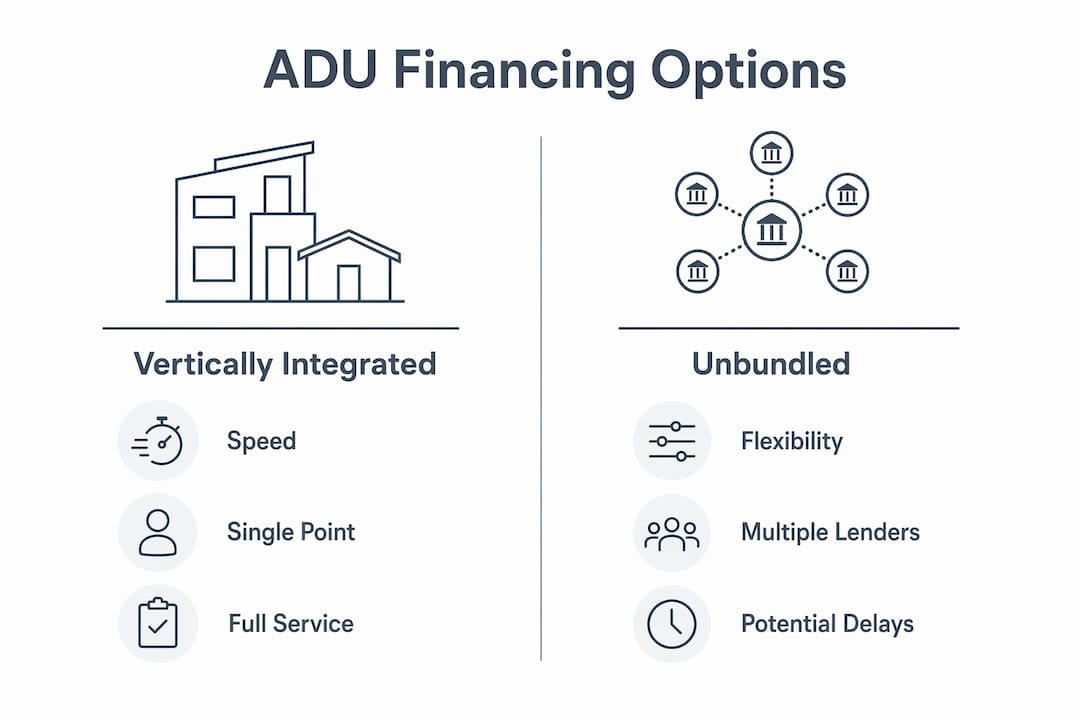
Table of Contents
- How do these financing alternatives compare in depth?
- How do you choose the best financing partner for your ADU project?
- Why lender independence and financing integration both matter for ADU investors
- Overview of financing alternatives to Orange Capital
- What timeline and costs should you expect for ADU financing?
- What do alternative lenders typically require for ADU financing?
- Live Large™ is a trusted alternative for ADU financing and development
- Key Takeaways
How do these financing alternatives compare in depth?
Underwriting philosophy: conservative vs. aggressive
Vertically integrated firms handle development, property management, and financing under one roof, which speeds up execution but reduces your control over each vendor relationship. Unbundled models let you hire a specialist contractor, choose your own lender, and negotiate each piece independently. Neither is universally better. The right choice depends on how much time you want to spend coordinating and how confident you are vetting subcontractors.

DSCR loans evaluate the property’s projected rental income rather than your personal W-2. That matters for ADUs because the unit’s income potential often qualifies you even when your personal income looks thin on paper. Traditional personal-income mortgages use a different calculation entirely, which can disqualify otherwise solid ADU investors. Construction loans fund the build in draws tied to completion milestones, then convert to a permanent mortgage. Home equity loans and HELOCs tap your existing property value and tend to carry lower rates than unsecured personal loans, though they put your primary residence on the line.
Service integration and lender independence
Independent lenders design portfolios around your goals rather than around their own fund inventory. A firm that only places capital into its proprietary products has an obvious incentive to recommend those products regardless of fit. That conflict is not always disclosed upfront. When a lender’s compensation depends on placing you in a specific fund, the advice you receive is shaped by that dependency.
Snapadu.com positions itself as a digital ADU financing platform with online tools designed to speed up the application and approval process. For borrowers comfortable with a self-directed digital workflow, that can cut weeks off the timeline. Small Lofts brings hands-on construction expertise into the financing conversation, which changes the dynamic: you’re not just getting a loan, you’re getting a team that understands what the build actually costs and what can go wrong.
| Factor | Vertically Integrated | Unbundled |
|---|---|---|
| Speed of execution | Faster, single point of contact | Slower, multiple vendors |
| Owner control | Lower | Higher |
| Lender independence | Often limited | Fully independent |
| Best loan types | DSCR, construction-to-perm | Any product on market |
| Ideal for | First-time ADU investors | Experienced developers |
How do you choose the best financing partner for your ADU project?
The single most useful filter is whether the lender’s underwriting standards match your project’s actual risk profile. A lender who promises aggressive returns or glosses over vacancy risk is telling you something about how they’ll behave when your project hits a snag.
Key evaluation criteria:
- Specialization: Does the lender have documented experience with ADUs or small footprint homes, not just general residential mortgages?
- Geographic coverage: Are they licensed and active in your state? Orange Capital Group focuses on Central New York and select secondary markets. If your project is in Tampa or Phoenix, that matters.
- Loan type fit: DSCR loans suit rental-income ADUs; construction loans suit ground-up builds; HELOCs suit homeowners with equity who want lower rates.
- Lender independence: Does the firm place capital only in its own funds, or can it shop the broader market for your best rate?
- Transparency: Can you get a detailed project summary or fund overview before committing? Reputable lenders offer confidential fund overviews on request, not just marketing decks.
- Fee structure: Origination points, prepayment penalties, and draw fees on construction loans add up fast. Get the full cost picture in writing.
Common red flags:
- Projected returns that sound too clean, with no discussion of downside scenarios
- Vague answers about how borrower rates are set
- No clear explanation of the loan-to-value ratio or debt service coverage requirements
- Pressure to commit before you’ve reviewed the full fund or loan documents
Pro Tip: Request a confidential fund or project overview from any lender you’re seriously considering. Firms with nothing to hide send it quickly. Those who deflect or push you toward a sales call instead are showing you their process.
Why lender independence and financing integration both matter for ADU investors
The tension between integration and independence is real, and it plays out differently depending on your goals.
Benefits of vertically integrated ADU financing:
- One team handles permitting, design, construction, and loan origination
- Fewer coordination gaps between the build timeline and draw schedule
- Easier for first-time ADU owners who don’t want to manage multiple vendors
Benefits of independent financing partnerships:
- Access to the full market of loan products, not just proprietary offerings
- Unbiased advice on loan structure, since the lender has no stake in a specific fund
- Flexibility to diversify your small home portfolio across multiple lenders and property types
- Better negotiating position on rate and terms when lenders compete for your business
Independent financing firms allow more tailored portfolios and unbiased advice, a critical factor for investors who are sensitive to proprietary product placements. That’s not a minor point for ADU investors building a multi-unit strategy over several years.
Overview of financing alternatives to Orange Capital
The ADU financing market has expanded considerably as cities and states have loosened zoning restrictions. Florida, for example, has seen significant ADU policy reforms at the municipal level, opening up new opportunities for homeowners and investors alike. That regulatory shift has pulled more lenders into the space.
Beyond DSCR loans and construction products, personal loans remain an option for smaller ADU projects, though rates run higher and terms are shorter. Some credit unions offer ADU-specific programs with favorable terms for members. State housing finance agencies in California, Oregon, and Washington have launched dedicated ADU loan programs with below-market rates for owner-occupants. For investors comparing financing platforms across the market, resources like alternative mortgage platform comparisons can surface options that don’t show up in a standard Google search.
What timeline and costs should you expect for ADU financing?
Construction loan approvals typically take 30–60 days from application to close, longer if the lender requires an independent appraisal of the completed value. DSCR loan approvals can move faster, sometimes 21–30 days, because the underwriting focuses on the property rather than a full personal income review. HELOCs are often the quickest to close if your equity position is clean and your credit is strong.
Costs vary by loan type. Construction loans carry origination fees, inspection fees for each draw, and often a higher rate during the build phase before converting to permanent financing. DSCR loans typically include origination points and may have prepayment penalties if you sell or refinance within the first few years. Budget for appraisal fees, title insurance, and closing costs on top of the stated rate regardless of which product you choose.
What do alternative lenders typically require for ADU financing?
Most alternative lenders for ADU projects look at a combination of credit profile, property equity, and project documentation. A credit score of 680 or above opens most DSCR and construction loan programs, though some lenders set the floor at 700 or higher for the best rates. Improving your credit profile before applying, even by 20–30 points, can meaningfully shift your rate.
Standard documentation includes property ownership records, a detailed construction budget and timeline, contractor licenses and insurance, and projected rental income for DSCR underwriting. Some lenders also require a feasibility study or appraisal of the completed ADU value before approving a construction loan. Gathering this documentation before you approach lenders cuts weeks off the process and signals that you’re a prepared borrower.
Live Large™ is a trusted alternative for ADU financing and development
If you want a team that handles ADU financing and construction together, rather than coordinating two separate vendors, Live Large™ and its Small Lofts brand are built for exactly that. The focus is on modern, small-footprint homes with a clean aesthetic and a financing approach grounded in real construction costs, not marketing projections.
Small Lofts combines ADU financing expertise with hands-on development experience, so the loan structure reflects what the build actually costs and what the completed unit will realistically earn. This integration matters when you’re trying to close a construction loan against a draw schedule that has to match real milestones. For homeowners in markets where ADU policy is actively evolving, like Pasco County, having a team that tracks regulatory changes alongside your financing is a real advantage. Contact Live Large™ to request a project consultation and get a financing overview tailored to your specific property and goals.
Key Takeaways
The most effective approach to ADU financing is matching your loan type to your project structure and choosing a lender whose underwriting philosophy aligns with your long-term investment goals.
| Point | Details |
|---|---|
| Loan type determines eligibility | DSCR loans qualify on rental income; construction loans fund builds in stages; HELOCs tap existing equity. |
| Lender independence reduces bias | Independent lenders shop the full market; proprietary fund firms may prioritize internal placement over your best rate. |
| Orange Capital’s geographic focus | Orange Capital Group centers on Central New York, with borrower rates typically ranging from 8% to 11%, making it a poor fit for out-of-market ADU projects. |
| Credit and documentation preparation | A credit score of 680 or above and complete project documentation improve approval odds and loan terms with alternative lenders. |
| Live Large™ integrates financing and construction | Small Lofts combines ADU financing with development expertise, aligning loan structure with real build costs and rental income projections. |