
An Accessory Dwelling Unit (ADU) is a self-contained living space with its own entrance, kitchen, and bathroom, built on the same lot as a primary residence. A house addition expands the main home’s square footage without creating a separate unit. The ADU vs house addition explained distinction matters because these two paths carry very different costs, zoning requirements, and financial outcomes. ADUs can generate rental income and boost resale value significantly. House additions improve daily living space for your existing household. Knowing which fits your goals before you break ground saves time, money, and frustration.
What does it cost to build an ADU vs a house addition?
Cost is the first filter most homeowners apply, and the gap between these two options is real. Detached ADUs cost $200–$400 per square foot nationally, rising to $300–$500 or more in high-cost areas like California. House additions run $150–$300 per square foot. That difference reflects the added complexity of building a fully independent unit.
Total project costs follow the same pattern. A detached ADU typically runs $220,000–$515,000 in total. A 500 sq ft home addition costs $130,000–$325,000 by comparison. Those ranges overlap at the high end, which surprises many homeowners who assume additions are always cheaper.

One cost driver that catches people off guard: second-story additions. Building up can cost $300–$500 per square foot due to structural reinforcement requirements. At that price point, a detached ADU on a flat lot may actually cost less.
ADUs carry higher costs because they require full independent infrastructure, including a separate kitchen, bathroom, HVAC system, electrical service, and plumbing. Every one of those systems must meet code as a standalone dwelling. A house addition, by contrast, taps into the existing home’s infrastructure and shares those systems.
Pro Tip: Get bids for both options before committing. Contractors who specialize in ADUs often identify lot constraints or utility upgrade costs that change the financial picture entirely.
| Scenario | Estimated cost range |
|---|---|
| Detached ADU (national average) | $220,000–$515,000 |
| House addition (500 sq ft) | $130,000–$325,000 |
| Second-story addition | $300–$500 per sq ft |
| ADU in high-cost market (CA) | $300–$500+ per sq ft |
What are the key benefits and drawbacks of ADUs versus house additions?
The financial case for ADUs is strong when you factor in long-term returns. Homes with ADUs can sell for up to 35% more than comparable properties without them. That same data shows a 22% increase in long-term property appreciation. A house addition adds resale value too, but it does not generate income while you own the home.
Rental income changes the math significantly. ADUs in active rental markets generate $1,800–$3,500 per month in rent. That income stream can recoup construction costs in as few as 5–7 years. No house addition offers that kind of payback timeline.
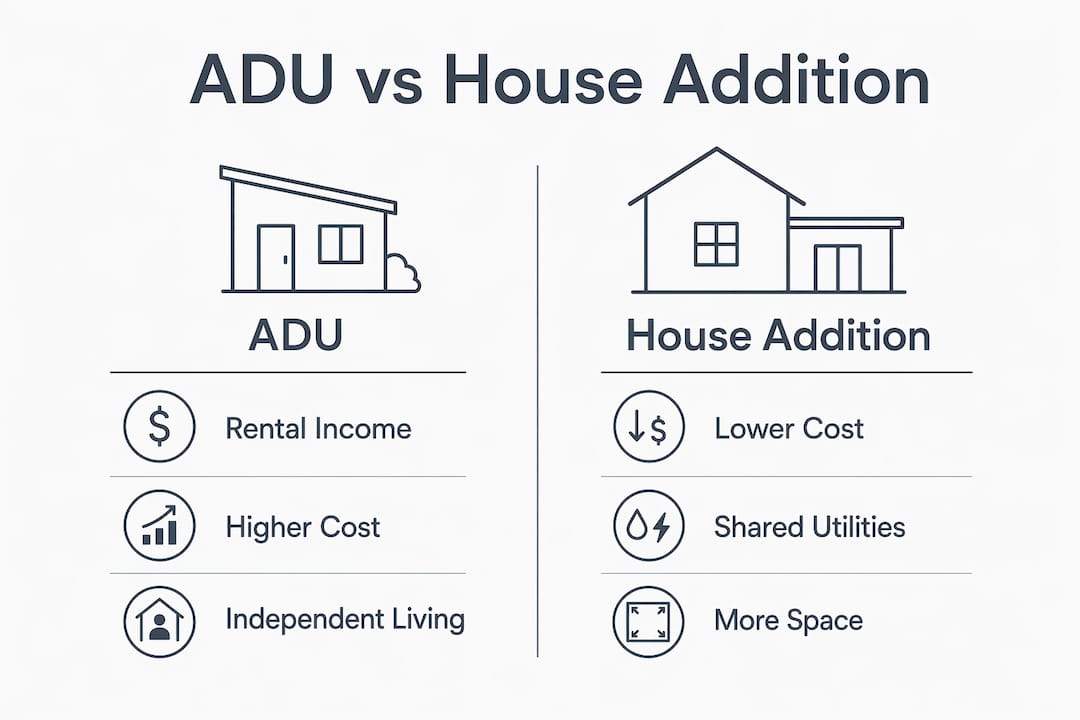
ADUs also serve multiple purposes over time. They work as rental units, private suites for aging parents, home offices, or guest quarters. ADUs offer a flexibility advantage that house additions simply cannot match because additions only expand shared household space.
ADU benefits:
- Generates monthly rental income
- Increases property value by up to 35%
- Provides private, independent living space for family members
- Serves multiple uses across different life stages
- Can outperform additions financially over a 10-year horizon due to rental income and tax advantages
ADU drawbacks:
- Higher upfront construction cost
- More complex permitting process
- Requires full independent utility infrastructure
- May reduce yard or outdoor space
House addition benefits:
- Lower cost per square foot
- Simpler permitting in most jurisdictions
- Integrates directly with your existing home’s layout and systems
- No reduction in private outdoor space if built outward on a single story
House addition drawbacks:
- No rental income potential
- Smaller impact on long-term property appreciation
- Second-story additions can rival ADU costs
- Zoning restrictions may limit how much you can add
Pro Tip: If your primary goal is passive income, an ADU is the only option that delivers it. If your goal is more bedroom or living space for your household, an addition is simpler and faster to build.
How do design and construction considerations differ?
ADUs come in three configurations, and each one carries different design and legal implications. ADUs can be attached, detached, or internal. A detached ADU sits as a separate structure in the backyard. An attached ADU shares a wall with the main home but has its own entrance. An internal ADU converts existing space, like a garage or basement, into a separate unit.
House additions work differently. They physically extend the existing home’s footprint or add a floor. The new space connects directly to the main living area and shares all utilities. A house addition integrates with the existing home’s systems, sharing plumbing, HVAC, and electrical infrastructure. That integration makes additions faster and less disruptive to build in most cases.
Construction timelines reflect this complexity gap. A straightforward room addition can be completed in 3–6 months. A detached ADU with full utility hookups typically takes 6–12 months from permit approval to move-in. Internal ADU conversions fall somewhere in between, depending on the condition of the existing space.
Key design considerations by type:
- Detached ADU: Requires its own utility connections, foundation, and exterior finishes. Offers the most privacy for tenants or family members.
- Attached ADU: Shares a wall but needs soundproofing and a separate entrance. Less expensive than detached but more complex than an addition.
- Internal ADU (garage or basement conversion): Uses existing structure, which lowers cost. Ceiling height and natural light are common constraints.
- Room addition: Extends the home’s floor plan. Works best when the existing foundation and roof can accommodate the expansion without major structural changes.
Live Large™ specializes in ADU design considerations and helps homeowners evaluate which configuration fits their lot, budget, and goals before any permits are filed.
What zoning and permitting issues should homeowners expect?
Zoning rules determine what you can build before your preferences matter at all. Local zoning restrictions like lot coverage and floor area ratio (FAR) limits can block house additions entirely, sometimes making an ADU the only legal way to add living space. Checking these constraints first saves months of wasted planning.
The permitting process differs significantly between the two options:
- House addition permits: Typically require a building permit, architectural drawings, and structural review. Most jurisdictions process these through a single department. Inspections cover framing, electrical, and final occupancy.
- ADU permits: ADUs often require multiple permits, including a building permit, a separate utility connection permit, and in many cities a rental license or certificate of occupancy as a dwelling unit. The review process involves zoning, building, and sometimes fire departments.
- Setback requirements: ADUs must meet setback rules from property lines, which vary by city and state. A detached ADU in the backyard may need to sit 4–10 feet from the rear and side property lines.
- Size limits: Many jurisdictions cap ADU size at 800–1,200 square feet or a percentage of the main home’s square footage. House additions face FAR limits but rarely have a hard square footage cap.
- Rental regulations: ADUs used as rentals may require annual inspections, rental registration, and compliance with local habitability standards. House additions used for personal use face no such requirements.
Recent policy shifts are making ADU permitting easier in many states. Tampa’s accessory dwelling unit policy reforms and Pasco County’s ADU approvals show how local governments are reducing barriers to ADU construction. Checking your city’s current rules before hiring a designer is the single most time-saving step you can take.
Key takeaways
ADUs generate rental income and long-term appreciation that house additions cannot match, but they cost more upfront and require more complex permitting.
| Point | Details |
|---|---|
| Cost gap is real but not absolute | ADUs cost $200–$400 per sq ft nationally; additions cost $150–$300, but second-story builds can close that gap. |
| ADUs generate income | Rental income of $1,800–$3,500 per month can recoup ADU costs in 5–7 years. |
| Resale value favors ADUs | Homes with ADUs sell for up to 35% more than comparable properties without them. |
| Permitting is more complex for ADUs | ADUs require multiple permits and often a rental license; additions typically need one building permit. |
| Zoning determines feasibility | Check lot coverage and FAR limits first. Zoning rules may make an ADU the only viable option. |
My take after working through hundreds of ADU projects
Homeowners almost always ask the wrong first question. They ask “which is cheaper?” when they should ask “what do I want this property to do for me in 10 years?”
If you want more space for your family and nothing else, a house addition is the right call. It is simpler, faster, and connects directly to how you already live. But if you have any interest in rental income, housing a family member independently, or building long-term equity, an ADU wins on nearly every financial metric once you look past the upfront cost.
The mistake I see most often is homeowners who skip the zoning check and spend months designing a beautiful addition, only to find out their lot coverage is already maxed. That discovery kills the project or forces a complete redesign. Check your zoning constraints on day one, not day sixty.
One more thing worth saying plainly: the permitting complexity of ADUs is real, but it is manageable. Cities like Tampa and Pasco County have actively simplified their ADU approval processes. Florida lawmakers are pushing for more ADUs statewide as a housing affordability solution. The regulatory environment is moving in the right direction. Homeowners who act now benefit from that momentum before demand and construction costs climb further.
— Rudy
How Live Large™ helps you move from decision to development
Choosing between an ADU and a house addition is only the first step. The real work starts when you need to evaluate your lot, understand local zoning, secure financing, and find a builder who knows what they are doing.

Live Large™ covers the full path from planning to installation for accessory dwelling units and small footprint modern homes. Whether you are weighing passive income potential or trying to understand how recent Tampa ADU policy changes affect your project, the Live Large™ team brings hands-on experience to every stage. Use the HELOC payment calculator to model your financing options before your first contractor call. Reach out to Live Large™ to get a clear picture of what is actually buildable on your lot.
FAQ
What is an ADU?
An ADU, or Accessory Dwelling Unit, is a self-contained residential unit on the same lot as a primary home, with its own entrance, kitchen, and bathroom. It can be detached, attached, or converted from existing space like a garage or basement.
Which costs more to build, an ADU or a house addition?
ADUs generally cost more upfront, running $200–$400 per square foot nationally compared to $150–$300 for house additions. However, second-story additions can reach $300–$500 per square foot, narrowing the gap considerably.
Can an ADU generate rental income?
Yes. ADUs in active rental markets generate $1,800–$3,500 per month in rental income, which can recoup construction costs in 5–7 years. House additions do not generate rental income.
How do I choose between an ADU and a house addition?
Check your zoning rules first to confirm what is legally buildable on your lot. If you want rental income or independent living space, an ADU is the stronger financial choice. If you need more connected living space for your household, a house addition is simpler and faster to complete.
Do ADUs increase home resale value more than additions?
Homes with ADUs sell for up to 35% more than comparable properties without them and show a 22% higher long-term appreciation rate. House additions add resale value but do not produce the same appreciation premium.