
Most accessory dwelling units need water, sanitary sewer, and electrical connections at minimum, plus gas and telecom for a full-time rental. The simplest path is sharing your existing services when your city allows it. If you’re splitting the parcel or local rules say otherwise, budget for separate meters and a new sewer lateral instead. Call your utility and permit office first, and ask for a residential load calculation and a plumbing fixture-unit count before you price anything else.
TL;DR:
- Sharing existing utility services is generally cheaper and faster unless local rules or parcel splits require separate meters and new laterals.
- Permit processes involve multiple applications, including building, plumbing, electrical, and sewer permits, with fees scaled to the ADU’s impact on system capacity.
- Water and sewer connections depend on existing capacity, parcel split requirements, and site slope, with grinders or ejector pumps needed on sites without proper gravity flow.
- An electrical service upgrade often becomes necessary when adding a full-size ADU to a home with a maxed-out panel, especially if electric appliances or heat pumps are planned.
- Utility hookup timelines range from eight to sixteen weeks and should include coordination with licensed contractors and upfront site, fixture, and load planning.
Table of Contents
- What Determines Whether You Share or Build Separate Utility Connections
- Permits and Connection Fees: What to Expect and Where Costs Come From
- How Do Water and Sewer Connections Actually Work?
- Electrical and Gas: When Do You Need a Service Upgrade?
- Phone, Internet, Cable and Final Meter Decisions
- Realistic Timeline and Who to Hire
- Common Technical Pitfalls and How to Avoid Them
- Sharing Utilities vs. Going Independent: What Actually Pays Off
- How Live Large™ Handles Utility Coordination for You
- Primary Municipal and District Pages to Check First
- Sources
- FAQ
What Determines Whether You Share or Build Separate Utility Connections
Three things decide your ADU utility connections scope: your parcel status, your unit type, and your site’s physical constraints.
If you’re splitting your lot into two legal parcels, most jurisdictions require independent utilities for each one, and many ADU fee exemptions disappear the moment that split happens. A junior ADU, by contrast, typically has to share water, sewer, and electric with the main house. JADUs generally can’t get a separate address in most states, which keeps their utility costs lower but limits their appeal as a standalone rental.
Beyond legal structure, physical reality matters just as much:
- Slope and gravity: flat lots often can’t drain to the street without mechanical help.
- Existing service capacity: an older 100-amp panel or a small water meter may not support added load.
- Septic systems: properties on septic face different rules than those on public sewer.
- Size thresholds: many jurisdictions waive certain impact fees for smaller units, with California’s ADU handbook citing exemptions for smaller ADUs and JADUs.
Permits and Connection Fees: What to Expect and Where Costs Come From
Utility installation for an ADU rarely comes down to one permit. Expect to pull several permits, often from different departments:
- Building permit from your city or county planning department, covering the structure itself.
- Plumbing permit for water supply lines and sewer connections.
- Electrical permit for new circuits, subpanels, or service upgrades.
- Sewer lateral permit, often issued separately by a sanitary district rather than the city.
- Encroachment or right-of-way permit if any work touches the street or public easement.
Fee structures vary by district but generally include a connection or capacity fee, a plan review charge, and separate inspection fees. The California ADU handbook directs jurisdictions to scale these charges proportionally to the ADU’s actual burden on the system rather than billing it like a brand-new house. Some sanitary districts, like Oro Loma, publish fee schedules showing these connection charges can vary depending on ADU size and construction type.
Before you contact anyone, assemble your site plan, fixture count, floor plan, and property survey. Utilities and districts almost always ask for these upfront, and showing up without them just adds a week to your timeline. A permit workflow guide can help you organize this packet before your first submission.
How Do Water and Sewer Connections Actually Work?
Water starts with a meter decision. Portland’s ADU connection guidance allows shared service for many ADUs, meaning your existing meter covers both structures, sized against your combined fixture count. A plumber calculates fixture units using standardized tables. A quick primer on how fixture units work is worth reading before you assume your current meter can handle the load. If you want a separate meter, most cities will install it, but you pay for the tap and any trenching in the public right-of-way. Property-side plumbing is on you either way.
Sewer works similarly. Branching your ADU into the existing lateral is cheaper and faster when the pipe has capacity and a gravity path exists. A parcel split usually forces a brand-new, independent lateral, and Portland’s guidance and district fact sheets from providers like Union Sanitary District both confirm this as a common trigger point.
Pro Tip: Pull your sanitary district’s standard detail drawings before your contractor bids the job. Slope and cleanout specs differ enough between districts that a bid based on generic assumptions almost always comes back low.
Technical specs you’ll run into:
- Minimum lateral diameter is commonly 4 inches across many district specs.
- Slope requirements often approximate 2%, matching a common industry rule of roughly a quarter inch of drop per foot of run.
- Cleanouts are required near the ADU kickout point, and often at property line and direction-change locations.
- Backwater valves are required where sewer backup risk exists, particularly on lower floors or flat sites.
If your site can’t achieve gravity flow, a grinder or ejector pump is typically required. That means added cost for the pump itself, an alarm system for power or high-water failures, and a maintenance obligation the homeowner carries indefinitely.
Electrical and Gas: When Do You Need a Service Upgrade?
Your electrician starts with a residential load calculation, adding up your ADU’s expected draw (HVAC, water heater, kitchen appliances, general lighting) against what your existing service can deliver. A 100-amp panel serving a full-size house may have little headroom left, and once you add an ADU with electric cooking and heat pump HVAC, an upgrade to a larger service, sometimes around 200 amps, or occasionally a full new service, becomes the practical answer.
You have two main paths:
- Add circuits to the existing panel if there’s spare capacity, running new wiring to a subpanel inside the ADU. This is the cheaper option when it’s physically feasible.
- Install a detached subpanel or entirely new service when the main panel is maxed out. Detached subpanels need their own grounding electrode system, not just a shared ground back to the main panel.
For homes considering solar alongside the ADU, California’s Title 24 rules interact directly with your electrical load math. A breakdown of the 1.8 kW exemption rule explains how some smaller ADUs can skip solar mandates depending on panel size and orientation.
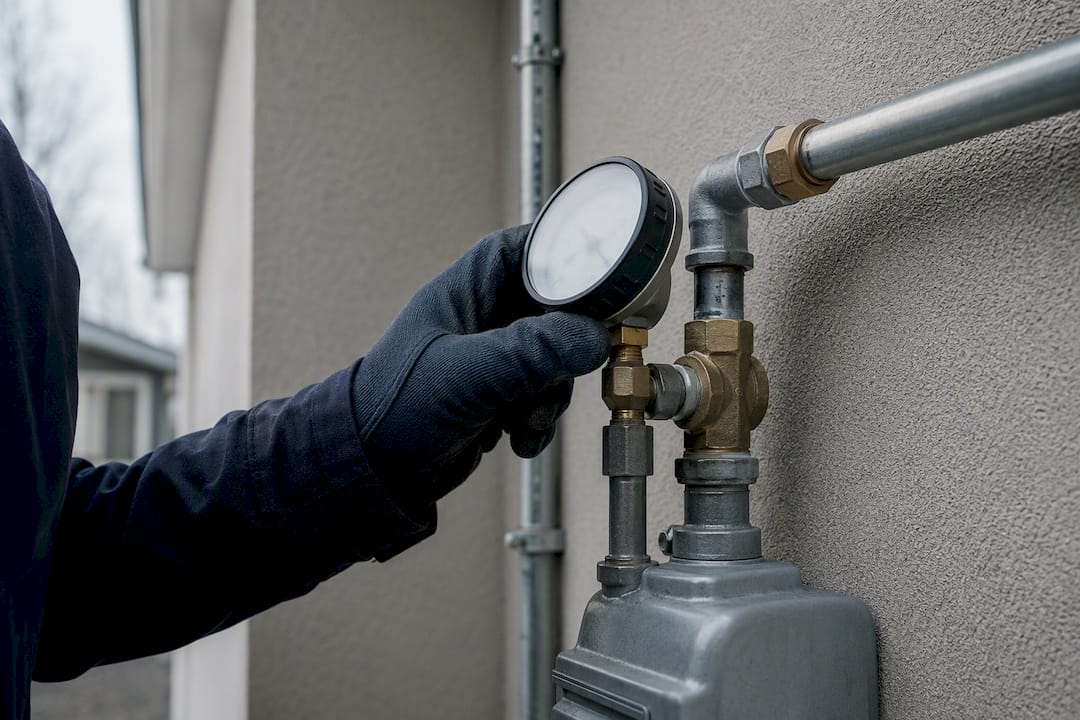
Gas works on a smaller scale but follows the same logic. Extending an existing gas line to a detached ADU usually needs its own permit and pressure test. A separate gas meter is typically required only when the ADU is on a separate parcel or when the utility company’s policy calls for individual metering per dwelling.
Phone, Internet, Cable and Final Meter Decisions
Telecom is the easiest hookup on the list. Call your provider once your structure is close to complete, request a service drop, and expect anywhere from a few days to a few weeks depending on whether it requires new trenching or just a tap into an existing line.
- Addressing: standard ADUs on the same parcel usually keep the main address with a unit suffix; JADUs almost never get separate addresses.
- Billing: separate meters mean separate utility bills, which matters for landlords who want tenants paying their own usage.
- Small fees: expect modest meter set fees and possible minor trenching charges even for shared-service setups.
- Scheduling tip: request your telecom drop the same week as your final electrical inspection so you’re not waiting on two separate crews to close out the project.
Realistic Timeline and Who to Hire
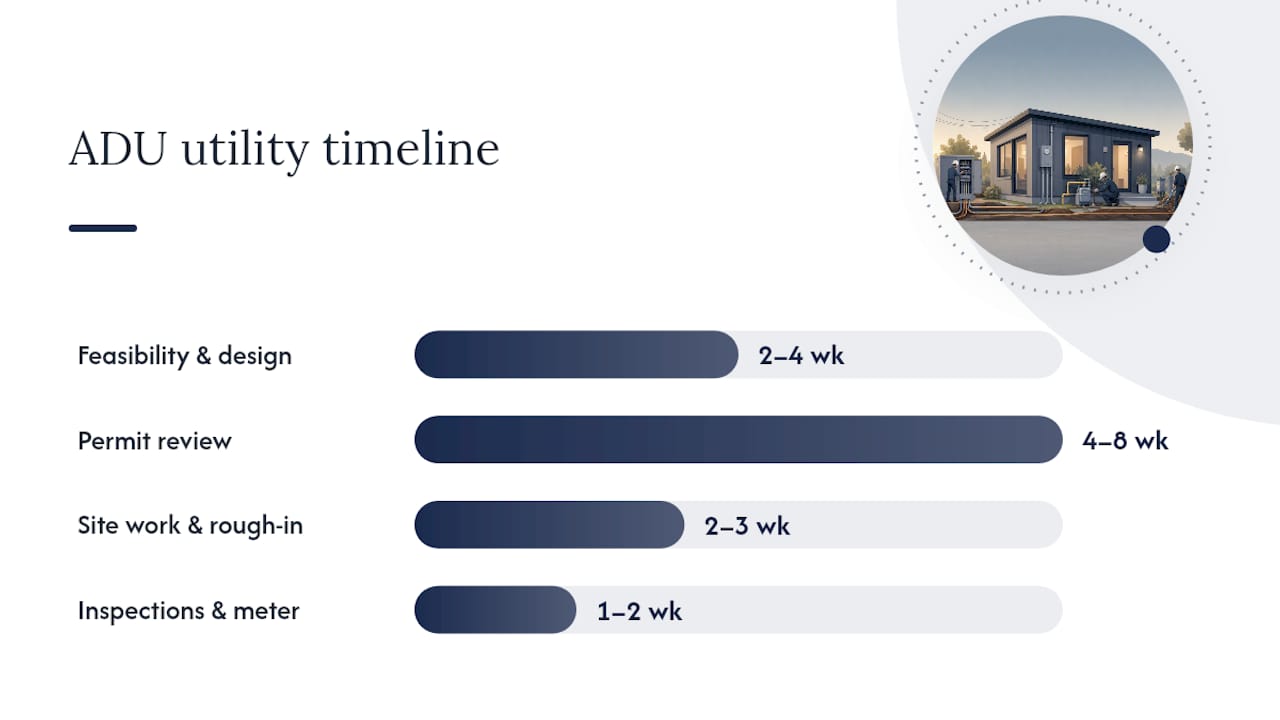
From feasibility study to final meter set, most ADU utility installation runs eight to sixteen weeks, though permit backlogs in busy cities can stretch that further. The sequence matters more than the calendar:
- Feasibility and design, including fixture-unit and load calculations, typically two to four weeks.
- Permit submission and review, often the longest single stretch, running four to eight weeks depending on jurisdiction.
- Site work and rough-in, covering trenching, lateral installation, and rough electrical, usually two to three weeks.
- Utility inspections and meter scheduling, which can add another one to two weeks if your inspector and utility scheduler aren’t coordinated.
- Final inspection and service activation, the last step before occupancy.
Hire a licensed plumber with actual sewer lateral experience, not just fixture rough-in work, plus a licensed electrician for load calculations and panel work. Bring in an excavation contractor for trenching and a civil engineer if your site has real slope or drainage complexity.
Pro Tip: When comparing contractor bids, check who is actually pulling the permits. A bid that’s silent on permit responsibility usually means you’re pulling them yourself, which adds weeks you didn’t plan for.
Common Technical Pitfalls and How to Avoid Them
Gravity drainage needs roughly a quarter-inch drop per foot, close to a 2% slope, according to Portland’s utility guidance. Without it, you’re locked into a grinder or ejector pump, full stop.
- Missing or misplaced cleanouts are one of the most common inspection failure points.
- Insufficient pipe cover depth causes failed inspections almost as often as slope issues.
- Using non-approved pipe materials for the local district triggers rework, not just a note on the inspection report.
Pumped systems need alarms for both power loss and high water, and those systems need periodic maintenance. Design for access to the pump vault and backwater valve now. Burying either one under a finished patio is a mistake you’ll regret the first time something fails.
Sharing Utilities vs. Going Independent: What Actually Pays Off
Sharing utilities makes sense when your goal is minimizing upfront cost and disruption, especially for a family member ADU with no rental ambitions. Separate meters cost more upfront but pay off when you’re renting to a tenant who expects their own bill, or when you’re building for resale value on a future parcel split. Financing decisions often follow the same logic. A HELOC covering a modest shared-service ADU looks very different from a construction loan funding independent utilities on a subdivided lot. If you’re managing the unit as a rental long-term, the separate meter usually wins on paper within a few years of tenant turnover.
— Rudy
How Live Large™ Handles Utility Coordination for You
A coordinated service can take the utility guesswork off your plate entirely. Instead of juggling separate calls to your water district, electrician, and permit office, such a service can coordinate feasibility studies, permitting, and utility hookups as one managed process, so the load calculation, fixture count, and lateral decision all happen before you’re locked into a contractor bid.
That coordination extends into financing. Live Large™ helps homeowners work through HELOC financing options and offers a payment calculator so you know your monthly number before utility costs even get finalized. Investors get the same turnkey treatment, from initial site evaluation through installation and occupancy.
If you’re at the point of deciding between shared services and separate connections, that’s exactly when to bring in Live Large™. Visit the homeowner services page to start a consult and get a clear scope on your ADU’s utility needs before you commit to a contractor.
Primary Municipal and District Pages to Check First
Before pricing anything, check these sources directly:
- Your city’s ADU utility guidance page, similar to Portland’s connections page, for meter and lateral rules.
- Your local sanitary district’s ADU fact sheet, like Union Sanitary District’s, for pipe specs and fees.
- Your state’s ADU handbook, such as California’s HCD handbook, for fee exemption thresholds.
These pages confirm whether your specific ADU needs a separate lateral or meter before you spend money on design.
Sources
- Portland
- ACCESSORY DWELLING UNIT HANDBOOK March 2026
- ACCESSORY DWELLING UNIT (ADU) FACT SHEET July 2023
FAQ
Is a shared meter or separate meter better for an ADU?
Shared meters cost less upfront and work well for family-use ADUs; separate meters cost more but make sense for rentals where tenants pay their own utility bills.
Who pays for a new sewer lateral?
The homeowner typically pays for a new sewer lateral, including permit fees, trenching, and connection charges from the sanitary district.
What triggers the need for a grinder or ejector pump?
A site without enough gravity slope, roughly a 2% grade or quarter inch per foot, requires a grinder or ejector pump to move sewage to the main line.
Do JADUs need separate utility connections?
No, JADUs typically share water, sewer, and electric service with the main house and usually cannot get a separate address in most states.
How long does ADU utility hookup usually take?
Most ADU utility installation, from feasibility through final inspection and meter activation, takes eight to sixteen weeks depending on local permit backlogs.