
There is no federal income tax credit for the cost of building an accessory dwelling unit. Construction costs get capitalized, not written off, and the real tax value comes from three places: energy-efficiency credits on qualifying equipment, depreciation once you rent the unit out, and state or local property tax exemptions. Check your county assessor’s ADU page before you break ground, and start tracking every invoice now, because your paper trail matters more than any single credit.
TL;DR:
- Federal energy credits for ADUs only apply to qualifying equipment, with a 30% deduction limit and annual caps that reset each year.
- Most construction costs are added to the property’s basis and recovered through depreciation if rented, not directly deducted as part of the build.
- State and local programs offer grants, exemptions, or phased-in property tax assessments, but eligibility varies widely by jurisdiction and requires early application.
- Renting an ADU allows depreciation deductions over 27.5 years and can generate significant tax benefits, but proper recordkeeping and cost allocation are essential.
- Building an ADU typically raises property taxes immediately upon assessment, so owners should seek preliminary estimates to avoid surprises.
Table of Contents
- What Federal Tax Credits Apply to ADU Construction?
- Which State and Local ADU Programs Offer Grants or Exemptions?
- How Does Renting an ADU Change Your Tax Picture?
- How Much Will an ADU Raise Your Property Taxes?
- How Should You Finance an ADU to Protect Tax Benefits?
- What We See Work Best With ADU Clients
- What Do You Need to Document to Claim These Benefits?
- Do ADU Benefits Reduce Other Homeowner Tax Credits?
- A Homeowner’s Priorities Differ from an Investor’s
- Sources
- FAQ
What Federal Tax Credits Apply to ADU Construction?
Nobody gets a check from the IRS for pouring a foundation. The Energy Efficient Home Improvement Credit is the closest thing to a federal ADU tax credit, and it only rewards specific equipment, not the build itself.
Under Form 5695, you can claim 30% of the cost of qualifying items installed in your home or ADU, subject to annual caps that reset every tax year rather than applying once over the life of a project. That distinction trips people up constantly: install a heat pump in year one and a new set of energy-efficient windows in year two, and you get to claim both years’ caps separately.
Items that typically qualify when installed in an ADU:
- Qualified heat pumps and heat pump water heaters
- Energy-efficient exterior windows and doors
- Insulation and air-sealing materials
- Qualified home energy audits
If you’re adding solar panels or a battery storage system to power the ADU, the Residential Clean Energy Credit is a separate program with its own percentage and no annual dollar cap, though it phases down over time. The two credits can stack when a project includes both efficiency upgrades and clean energy equipment, but each has its own qualifying rules and paperwork.
Here’s the part that gets glossed over: a tax credit reduces what you owe dollar for dollar. A deduction just reduces the income you’re taxed on. Most ADU costs, framing, drywall, plumbing rough-in, electrical panels, don’t qualify for either. They get added to your cost basis and recovered slowly through depreciation if you rent the space, or they simply increase your basis for when you eventually sell.
Pro Tip: Keep every equipment invoice separate from your general contractor invoice. If your builder bundles a heat pump into a lump-sum contract, ask for an itemized breakdown, because you can’t claim Form 5695 credits on a cost you can’t isolate.
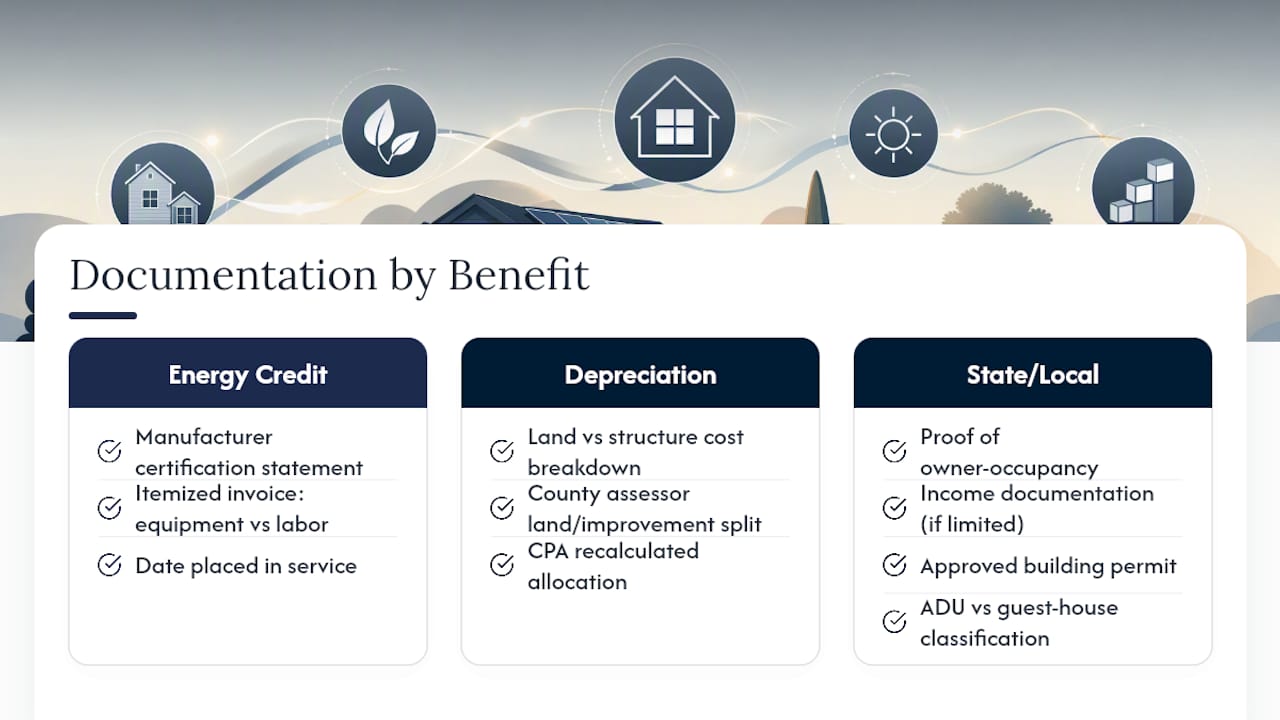
To claim any of these, keep manufacturer certification statements, dated invoices showing the equipment cost separately from labor, and proof of when the item was placed in service. File Form 5695 with your federal return for the year the equipment was installed, not the year construction started.
Which State and Local ADU Programs Offer Grants or Exemptions?
Real savings on ADUs usually come from your state or county, not the IRS. Programs fall into three distinct buckets, and mixing them up leads to disappointment when you apply for the wrong thing.
Grants hand you money upfront, often for predevelopment costs like architectural plans or impact fees, and typically come with income limits or owner-occupancy requirements. Credits reduce a tax bill dollar for dollar but are rare at the state level for ADU construction specifically. Exemptions don’t give you cash. They freeze or phase in the added property tax value so your bill doesn’t jump the moment the certificate of occupancy is issued.
A few representative examples worth knowing:
- California has run state-supported predevelopment grant programs through agencies like CalHFA for low- and moderate-income homeowners covering soft costs such as permitting and design fees.
- Maryland offers county-level incentive programs in some jurisdictions that help offset ADU permitting or impact fees for qualifying homeowners.
- New York’s RP-421-p exemption lets local governments phase in the added assessed value from ADU construction over several years, with a cap on the value increase eligible for exemption, rather than taxing the full new value in year one.
Because these programs are legislated locally and often adopted county by county or city by city, the same state can have wildly different rules two counties apart, similar to how Tampa’s recent ADU policy reforms changed the local landscape without shifting anything statewide.
To find what applies to you, check your state housing finance agency’s website, your county assessor’s ADU-specific page, and your municipality’s planning department. Most require an application before construction starts, not after.
Pro Tip: Program availability shifts year to year based on funding cycles. Confirm directly with the issuing agency in 2026 rather than relying on a blog post or a neighbor’s experience from two years ago.
How Does Renting an ADU Change Your Tax Picture?
Renting your ADU unlocks depreciation, and that’s where the real annual tax benefit lives for most owners. Here’s how the mechanics actually work.
- Establish your depreciable basis. Take your total construction cost and subtract the value of the land underneath it, since land never depreciates. If your ADU cost $180,000 to build and sits on land the county assigns a nominal value to, your depreciable basis is close to that full construction figure.
- Depreciate over 27.5 years. IRS Publication 527 requires straight-line depreciation for residential rental property under MACRS. A $180,000 basis produces roughly $6,545 in annual depreciation, a deduction you take every year the unit is rented, regardless of whether it appreciates.
- Deduct ongoing operating expenses. Utilities, insurance, property management fees, and repairs, think a fixed leaking faucet or a repainted wall, are deductible in the year paid. Capital improvements, like adding a new HVAC system, get added to basis and depreciated instead.
- Report everything on Schedule E. Rental income and expenses flow through Schedule E, and passive activity loss rules generally limit how much rental loss you can deduct against other income. Active participation can unlock up to a $25,000 loss allowance, but that benefit phases out for taxpayers with modified adjusted gross income between $100,000 and $150,000.
Sell the property later, and depreciation recapture comes into play: the IRS taxes the depreciation you claimed at a rate up to 25%, separate from regular capital gains treatment. If part of your home was a personal residence and part was a rented ADU, the Section 121 exclusion on capital gains from a primary residence sale generally doesn’t cover the rental portion, so allocate carefully between the two uses.
How Much Will an ADU Raise Your Property Taxes?
Most counties assess a new ADU at market value once construction finishes, then add that figure to your existing improvement value. It’s a straightforward addition, but the dollar impact catches people off guard because they never asked ahead of time.
Ventura County’s assessor office explains this plainly: the ADU’s market value gets added to your assessed improvement value, and that increment, not your whole property, is what generates the higher tax bill.
| Small studio ADU | represents a moderate added value.
Approximately 1% typical rate | estimated proportionate increase |
| Mid-size one-bedroom ADU | represents a moderate added value.
Approximately 1% typical rate | estimated proportionate increase |
| Larger two-bedroom ADU | represents a greater added value.
Approximately 1% typical rate | estimated proportionate increase |
These figures are illustrative only. Actual rates vary by county, school district overlays, and special assessments, so treat this table as a way to think about scale, not a quote.
Some jurisdictions soften the blow. New York’s RP-421-p exemption phases in the added value over multiple years rather than taxing the full increase immediately, capped at a set dollar threshold on the value increase. Other counties offer no such cushion, so San Mateo County’s assessor office and others recommend contacting them with your conceptual plans before permits are pulled.
Pro Tip: Call your assessor’s office with your square footage and finish level before you sign a construction contract. Most will give you a preliminary estimate for free, and that number should factor into your financing decision.
How Should You Finance an ADU to Protect Tax Benefits?
Financing choice quietly determines how much interest you can actually deduct. A dedicated construction loan or HELOC used specifically for a rental ADU generally lets you deduct that interest as a straightforward rental expense on Schedule E.
Refinance your primary mortgage to pull out cash for the same project, and things get messier. IRS Publication 936 requires you to trace how refinanced proceeds were used, splitting interest between personal residence use and rental use. Lenders don’t track that allocation for you, so the burden falls on your records.
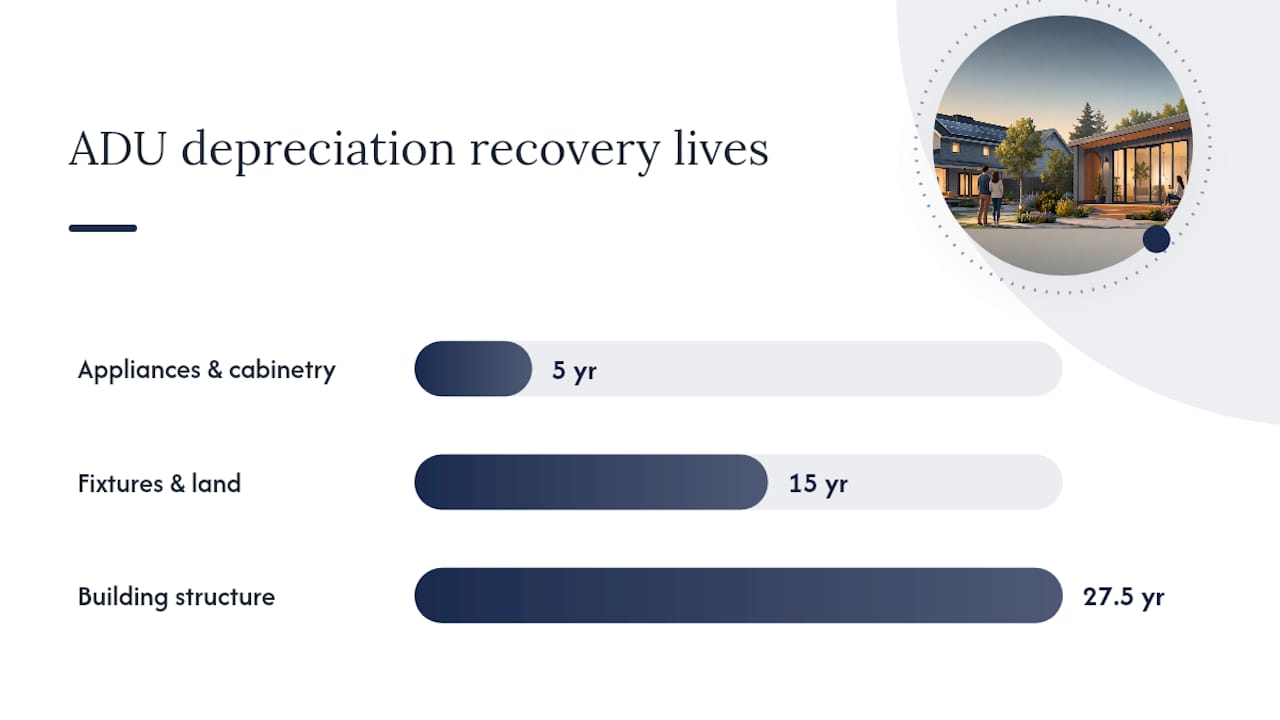
For investors running multiple units, cost segregation studies can accelerate depreciation by reclassifying components like appliances, cabinetry, and certain fixtures into 5 or 15-year recovery schedules instead of the standard 27.5 years. The structure itself stays on the long schedule and generally doesn’t qualify for full bonus depreciation. This is a genuinely useful tool, but it’s specialized enough that a tax professional should run the numbers before you commit.
Recordkeeping that actually holds up:
- Separate invoices by category: materials, labor, permits, professional fees, equipment
- Retain loan disbursement records showing exactly how each draw was spent
- Log personal-use days if you or family occasionally stay in the ADU
- Keep permits, inspection reports, and the certificate of occupancy in one file
One more wrinkle worth knowing: rent the ADU for 14 days or fewer in a calendar year, and that income is generally tax-free under the short-term rental exception, sometimes called the Masters Rule. The trade-off is you also can’t deduct rental expenses for those days, so it only makes sense for occasional, low-volume use.
What We See Work Best With ADU Clients
Clients are advised to prepare a specific document set before filing season: permits, itemized contractor invoices broken out by category, and loan disbursement records tied to each draw. Clients who call their county assessor early, before permits, consistently avoid the worst reassessment surprises. Financing with a dedicated loan rather than a refinance also saves hours of tracing work later. For allocation questions, cost segregation, or active participation analysis, that’s where a CPA earns their fee.
What Do You Need to Document to Claim These Benefits?
Claiming any ADU-related tax benefit starts with paperwork you should be collecting from day one, not scrambling for in April.
For federal energy credits under Form 5695, you need the manufacturer’s certification statement for each qualifying item, an itemized invoice separating equipment cost from installation labor, and the date the equipment was placed in service. Miss the certification statement and the IRS can disallow the credit even if the equipment genuinely qualifies.
For depreciation once you rent the unit, you need a clear cost breakdown separating land value from structure value, since only the structure depreciates. Your county assessor’s property record often shows a land-to-improvement split you can reference, though your CPA may recalculate it based on actual purchase or construction costs.
For state and local exemption programs, requirements vary widely but commonly include proof of owner-occupancy, income documentation if the program has income limits, and an approved building permit showing the ADU meets local zoning definitions. Distinguishing an ADU from a guest house matters here, since some jurisdictions apply different tax and permitting rules depending on how the structure is classified.
Missing documentation is the single most common reason applications for local exemptions get denied or delayed, more often than actual ineligibility. Build a folder, digital or physical, the day you sign your first contract.
Do ADU Benefits Reduce Other Homeowner Tax Credits?
Adding an ADU rarely disqualifies you from other homeowner benefits outright, but a few interactions are worth watching closely.
The $25,000 active participation loss allowance for rental real estate phases out between $100,000 and $150,000 in modified adjusted gross income, so higher-earning homeowners who add a rental ADU may find they can’t currently use rental losses to offset other income, even though the losses still accrue and carry forward.
Energy credits claimed on your primary residence and on an attached or detached ADU generally don’t compete against each other within the same tax year, since Form 5695’s caps apply per taxpayer per year across all qualifying property you own, not per structure. Install efficient windows in your main house and a heat pump in your ADU in the same year, and both draw from the same annual limit rather than getting separate allowances.
If you claim the mortgage interest deduction on a HELOC used partly for ADU construction, that interest may need to be split between deductible home-improvement interest and rental-expense interest depending on final use, which is exactly the tracing problem described above. The two benefits aren’t mutually exclusive, but claiming both correctly requires cleaner records than claiming just one.
A Homeowner’s Priorities Differ from an Investor’s
Homeowners should focus on avoiding reassessment shock and protecting the mortgage interest deduction. Investors should prioritize depreciation and consider cost segregation. Either way, gather your documents and call your assessor and a tax professional before construction starts. When you’re ready to build, Live Large™ can help with the documentation and permitting that make tax season easier.
— Rudy
Sources
- IRS Publication 527 (Residential Rental Property)
- Ventura County Assessor — Accessory Dwelling Units (ADU)
- Instructions for Form RP-421-p (NY property tax exemption for ADUs)
FAQ
Is Building an ADU a Tax Write-Off?
Not directly. Construction costs are capitalized rather than deducted, but you recover them through depreciation over 27.5 years once the ADU is rented, or you get a partial write-off through energy-efficiency equipment credits under Form 5695.
Who Qualifies for the Federal Energy Efficiency Tax Break?
Homeowners who install qualifying equipment, like heat pumps, efficient windows, or approved home energy audits, in a home or ADU can claim 30% of the cost through Form 5695, subject to annual dollar caps that reset each tax year.
Are California ADU Relief Programs Still Available in 2026?
Availability changes based on state and local funding cycles, so homeowners should confirm current status directly with their state housing finance agency or county program office rather than relying on older listings.
What Is One Drawback of Building an ADU?
Beyond construction cost, the added market value typically increases your property tax assessment as soon as the county assessor records the completed structure, and that increase can catch owners off guard if they didn’t request a preliminary estimate beforehand.