
ADU grants are real but scarce, geographically limited, and rarely enough on their own to fund a full build. A handful of state programs, like CalHFA’s ADU Grant Program in California, Colorado’s ADUG, and MassHousing’s ADULP in Massachusetts, plus federal HUD HOME dollars that flow through local agencies, cover pieces of the process. Start by checking your state housing agency’s website and the HUD HOME program list before you assume a grant will pay for construction.
TL;DR:
- Most ADU grants are limited to pre-development costs such as site planning, permits, and design, not full construction, with maximum reimbursements around $40,000.
- Qualification generally requires owning and occupying the property, meeting income limits, and living within jurisdictions that participate in specific programs.
- Application processes involve gathering proof of ownership, site plans, contractor estimates, and monitoring application deadlines through official portals.
- Funding amounts vary widely, with grants primarily covering pre-construction expenses and loans like MassHousing’s providing larger sums as debt, not free money.
- When grants are unavailable or insufficient, private financing options like HELOCs, refinancing, or construction loans are the most common ways to fund ADU projects.
Table of Contents
- What ADU Grant Programs Actually Exist Right Now
- Who Qualifies for These Grants and What They Cover?
- How Do You Apply for an ADU Grant?
- How Much Money Can You Actually Get?
- What If You Don’t Qualify for a Grant?
- Where to Find Local ADU Funding Fast
- Grants Help at the Margins. Financing Gets the Job Done.
- How Live Large™ Helps You Fund and Build Your ADU
- Sources
What ADU Grant Programs Actually Exist Right Now
Grant money for accessory dwelling units doesn’t come from one national fund. It comes from a patchwork of state agencies, local governments, and federal pass-through dollars, each with its own rules about what it covers and who qualifies. Understanding the three basic models makes it much easier to figure out where to look.
Some programs hand money directly to homeowners. Others fund local governments, which then run their own homeowner assistance. And a few states skip grants altogether in favor of below-market loans built specifically for ADU projects.
- Homeowner-facing grants: California’s CalHFA ADU Grant Program reimburses pre-development costs like site prep, architectural design, permits, and property surveys, with reimbursements that have reached up to $40,000 for eligible applicants.
- Government-to-government grants: Colorado’s Accessory Dwelling Unit Grant Program awards funding to certified local governments, called ADU Supportive Jurisdictions, which then use that money to help homeowners in their communities. Award amounts and application cycles are published on the state’s Division of Local Government site, and rounds have opened on a competitive, rolling basis.
- Program loans instead of grants: MassHousing’s Accessory Dwelling Unit Loan Program gives income-eligible homeowners affordable financing rather than free money, combining an amortizing loan with a zero-interest, deferred-repayment portion.
If you live outside California, Colorado, or Massachusetts, that doesn’t mean anything exists. It means you’ll need to dig into your own state or county housing department’s site, because these three are simply the best-documented examples in the country right now.
Who Qualifies for These Grants and What They Cover?
Eligibility rules vary by program, but the pattern repeats across most states: you generally need to own and occupy the property as your primary residence, fall under a set income limit, and build in a jurisdiction that has opted into the program. Colorado’s ADUG, for instance, only benefits homeowners in cities and counties that have already been certified as ADU Supportive Jurisdictions, so the first thing to check isn’t your income. It’s whether your local government even participates.
Coverage tends to focus on the expensive, invisible parts of a project rather than the visible build itself.
- Pre-development costs: site surveys, soil tests, architectural plans, and design fees
- Permitting and impact fees charged by the city or county
- Technical assistance, like help to navigate zoning or code requirements
- In some cases, closing costs tied to financing the project
Here’s the number that trips up most applicants: CalHFA’s grant tops out at $40,000, and that money is earmarked for pre-development and certain closing costs, not the framing, plumbing, and finish work that make up the bulk of a construction budget. Grants close the gap on paperwork and planning. They almost never pay for the building itself.
Before you assume you qualify, pull the program’s actual fact sheet and income-limit table. Most state and local sites publish these directly, and the numbers shift by county and household size, so a limit that excludes you in one jurisdiction might include you in the next town over.
How Do You Apply for an ADU Grant?
Applications move through official state or local portals, not through a phone call to a contractor. Colorado runs its own ADUG Grants Portal with fact sheets, guidelines, and application templates posted directly on the Division of Local Government site. California and Massachusetts route applications through their respective housing finance agencies.
- Gather proof of ownership and income verification documents first, since almost every program requires both before it will even open your file.
- Pull together site plans, or pre-approved ADU plans if your jurisdiction offers them, along with your current permit status or a realistic permitting timeline.
- Collect contractor estimates and any local matching-fund documentation your program requires.
- Sign up for the program’s email updates or newsletter so you know exactly when a funding round opens and closes.
- Watch recorded webinars or informational sessions where available. Colorado’s DLG posts these alongside its guidelines, and they often explain scoring criteria that never make it into the fact sheet.
- Submit your complete application inside the open round. Late or incomplete submissions are typically disqualified outright rather than held for the next cycle.
- Expect follow-up reporting or reimbursement steps after approval. MassHousing’s ADULP, for example, requires that you already have plans and permits in hand before you apply, since projects started before closing are ineligible.
Pro Tip: Build your documentation folder before a round even opens. Programs like ADUG post their fact sheets and templates months ahead of application deadlines, so the homeowners who get funded are usually the ones who started organizing paperwork while everyone else was still waiting for the announcement.
How Much Money Can You Actually Get?
Award sizes swing widely depending on which program model you’re dealing with. CalHFA’s reimbursement ceiling sits at $40,000 per eligible homeowner, but that ceiling only applies to pre-development and closing costs, not full construction. Colorado’s ADUG awards go to jurisdictions rather than individuals, and published award lists show that amounts vary by round and by the scope of the local program a city or county proposes.
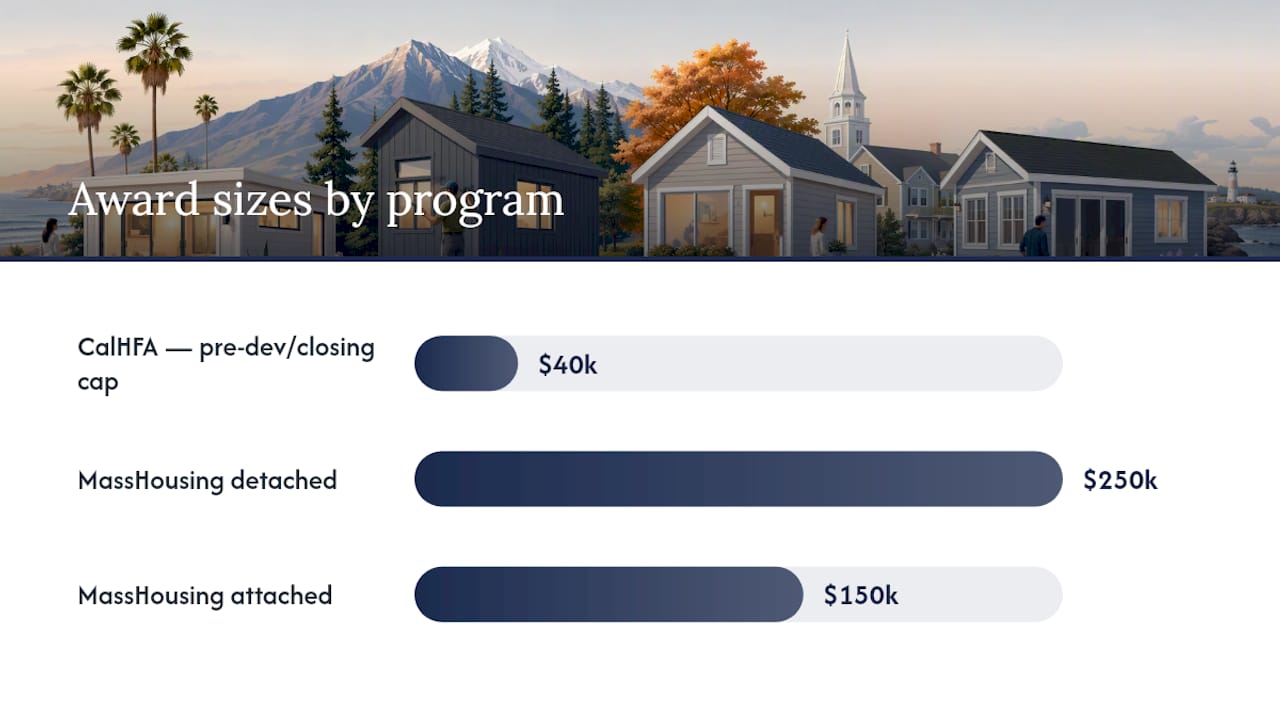
MassHousing works differently again. Its ADULP caps loans at $250,000 for detached ADUs and $150,000 for attached ADUs, blending a standard amortizing loan with a zero-interest, deferred-repayment piece. That’s meaningfully more money than any grant on this list, but it’s debt, not a gift.
A few limits show up across nearly every program:
- Geographic restrictions that exclude you entirely if your city or county hasn’t opted in
- Income bands that shift by household size and county, not a single national threshold
- A near-universal focus on pre-development costs rather than construction, so grants rarely fund a build start to finish
- Competitive rounds that close once funding runs out, sometimes within weeks of opening
When you read a program announcement, look for three things: the award size, whether a local match is required, and what reporting you owe after the money lands. Skipping that last part is how homeowners end up with reimbursement delays.
What If You Don’t Qualify for a Grant?
Most ADU projects in the United States get built with private financing, not government money, because grants are limited, competitive, and often geographically restricted. That’s not a failure of planning. It’s just the math of how few grant dollars exist relative to how many homeowners want to build.
- HELOCs and home equity loans: These let you borrow against equity you’ve already built, usually at lower rates than unsecured loans, and they work well when you own a good chunk of your home outright.
- Cash-out refinance: This replaces your existing mortgage with a larger one and hands you the difference in cash, which can make sense if current rates beat what you’re already paying.
- Construction-to-permanent loans: These fund the build in draws and then convert to a standard mortgage once the ADU is finished, which suits homeowners without much existing equity.
- Program loans like MassHousing’s ADULP: These blend affordable financing with income eligibility rules, sitting somewhere between a market-rate loan and a straight grant.
A detailed breakdown of HELOC, construction loan, and refinance options can help you figure out which fits your equity position and timeline. It’s also worth understanding how projected rental income from an ADU can factor into what a lender is willing to approve, since some loan products now count that future income toward your qualifying total.
Pro Tip: Get your financing lined up before you call a contractor, not after. Contractors and lenders both move faster for clients who show up with a funding plan already in hand, and projects with uncertain funding tend to sit lower on a builder’s schedule than jobs that are ready to start.
Where to Find Local ADU Funding Fast
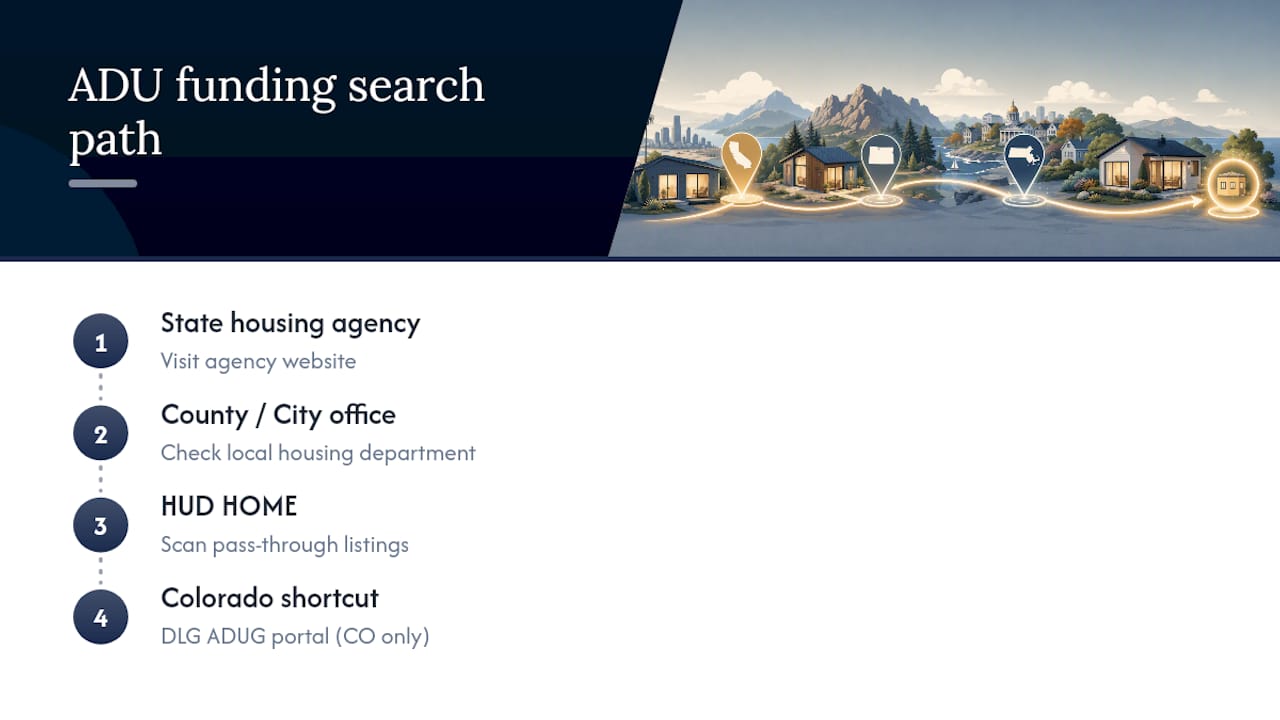
Start with your state housing finance agency’s website, then check your county or city housing department page, and finally scan the HUD HOME program list to see if your area receives federal pass-through funding. Colorado residents can go straight to the DLG ADUG portal for fact sheets and application templates.
Sign up for each program’s email newsletter, since that’s usually the fastest way to learn when a new round opens. Watch for red flags, too: CalHFA explicitly warns that funding rounds can become fully subscribed and that anyone offering to “get you” a grant for a fee is very likely running a scam. Legitimate programs never ask for upfront payment to apply.
Grants Help at the Margins. Financing Gets the Job Done.
Treat grants as a bonus, not a plan. The programs worth watching, CalHFA, Colorado’s ADUG, MassHousing’s ADULP, are useful, but none of them were built to fund a full ADU from foundation to finish. Secure a HELOC pre-approval or comparable financing first, then apply for any grant your state offers to offset pre-development costs.
This week, pull your home equity numbers, gather your site documents, and subscribe to your state program’s eNews. Some companies help homeowners coordinate financing conversations and permitting timelines so a project doesn’t stall waiting on a grant round that may never open.
— Rudy
How Live Large™ Helps You Fund and Build Your ADU
Some service providers handle parts of an ADU project that grants were never designed to cover: coordinating with lenders, guiding through HELOC financing, and managing design, permitting, and construction under one roof. Instead of juggling a grant application, a separate contractor bid, and a lender who’s never built an ADU before, you get one team that has already done the coordination work.

If you’re a homeowner who wants a straight answer on financing before you commit to a build, some firms offer services designed to assist with that first conversation. A good fit looks like this: you own your home, you have some equity or are open to exploring a HELOC, and you’d rather have one point of contact handle permitting and construction than manage five vendors yourself. Start by reviewing the Lender Ready ADU Checklist to see exactly what documentation speeds up approval, then check your financing options to see what a realistic budget looks like for your property. Ready to see numbers? Run your monthly payment estimate on the HELOC calculator and book a first call to walk through your site.
Sources
- ADU Grant Program – CalHFA
- Accessory Dwelling Unit Grant Program (ADUG) | Division of Local Government
- Accessory Dwelling Unit Loan Program
- Want to Add a Granny Flat or Rental ADU? Here’s How to Finance It – NerdWallet