
Most accessory dwelling units in the United States typically pay back their build cost within a range of several years, though that timeframe varies significantly based on your build cost, your local rent, and how you finance the project. A garage conversion in a strong rental market can recoup its cost relatively quickly. A financed detached unit in a low-rent area might take substantially longer. The rest of this guide walks through the math, a worked example, and a checklist so you can model your own number instead of trusting a generic estimate.
TL;DR:
- Most ADUs in the US pay back their build costs within 8 to 15 years, with conversions generally recouping faster than detached new builds.
- Payback calculations should factor in net rental income, local rent comps, financing costs, and potential property tax reassessments for accuracy.
- High-demand markets with elevated rents tend to have shorter payback periods, while inland or lower-rent areas often result in longer recoupment times.
- Including depreciation, appraisal uplift, and potential sale value increases can make slower cash flow ADUs a worthwhile investment if planning to sell within a decade.
- A detailed, property-specific financial model is essential before construction to account for all costs, delays, and market variables that influence payback time.
Table of Contents
- What Is the ADU Payback Period, and How Do You Calculate It?
- How to Calculate ADU Payback: A Step-by-Step Example
- What Factors Actually Move Your Payback Timeline?
- What’s a Realistic ADU Payback Range by Market and Type?
- How Do Taxes, Depreciation, and Appraisal Uplift Change the Math?
- What Should Your ADU Payback Checklist Include?
- How Long Does It Take from Decision to First Rent Check?
- The LiveLarge™ Take: How We Advise Clients on ADU Payback
- Get a Tailored ADU Payback Analysis from Live Large™
- Sources
What Is the ADU Payback Period, and How Do You Calculate It?
Payback period is the simplest measure of ADU return: how long until the rental income repays what you spent building it. It’s cruder than cash-on-cash return or net present value, both of which account for the time value of money and ongoing appreciation, but payback answers the question most owners actually ask first: when do I break even?
The formula is straightforward:
Payback years = total all-in build cost ÷ annual net income
Annual net income means rent collected minus vacancy, taxes, insurance, maintenance, and management, not gross rent. That distinction is where most online estimates go wrong.
- Simple payback: ignores financing costs, just cost divided by net rent
- Finance-aware payback: factors in monthly debt service from a HELOC, refi, or construction loan
- Total-return payback: adds appraisal uplift at resale into the equation
Statistic: Several ADU ROI calculators that run simple payback (ignoring financing) show most U.S. markets clustering between 8 and 15 years, with finance-aware models often landing between 7 and 10 years once realistic rents and expenses are applied.
How to Calculate ADU Payback: A Step-by-Step Example
Before you touch a calculator, gather five numbers: total all-in build cost (design, permits, site work, construction, utility hookups), expected monthly rent from comparable local units, a realistic vacancy rate (5 to 8% typical), monthly operating expenses, and your financing terms if you’re borrowing.
Once you have those, the math runs in four steps:
- Calculate gross annual rent (monthly rent × 12).
- Subtract vacancy loss and operating expenses to get net operating income.
- Subtract annual debt service (if financed) to get net cash flow.
- Divide total cost by net annual income to get years to payback.
Worked example: 600-square-foot garage conversion
Build cost: $95,000. Monthly rent: $1,600. Vacancy at 6%: minus $1,152/year. Operating expenses (taxes, insurance, maintenance, management): $3,800/year. Net operating income: about $15,300/year. All-cash payback: 6.2 years.
Contrast: 600-square-foot detached new build
Build cost: $220,000. Same rent and expenses apply. Net operating income: roughly $15,300/year. All-cash payback: 14.4 years.
Now finance the detached unit with a HELOC at a typical rate, and annual debt service might run $9,000 to $11,000, cutting net cash flow to $4,300 to $6,300 a year. Payback on cash invested drops sharply because you put less capital in up front, but the property carries debt for years longer. That’s the trade-off financing always creates. A financing options breakdown can help you weigh HELOC against cash-out refi or a construction loan for your specific numbers.
What Factors Actually Move Your Payback Timeline?
Build cost and ADU type set the floor. A conversion (garage, basement, attic) typically runs 40 to 60% of the cost of a detached new build in the same market, which is the single biggest reason conversions post faster payback almost everywhere.
Rent assumptions come next, and this is where owners most often fool themselves. Pulling three to five comps from actual listings in your zip code, not city-wide averages, keeps your projection honest.
- Financing rate and term determine how much of your rent goes to interest before it touches principal
- Property tax reassessment after permitting an ADU adds a real, recurring cost most owners underestimate
- Insurance riders, maintenance reserves, and management fees (if you’re not self-managing) all eat into net income
- Permit delays and change orders extend the “no income” phase while carrying costs keep accruing
Pro Tip: Run your rent estimate using the lowest of your three comps, not the average. If payback still looks acceptable at that number, you have real margin for error.
What’s a Realistic ADU Payback Range by Market and Type?
Garage and basement conversions in strong rental markets often pay back faster than detached new builds, which tend to cost more and take longer to recoup, depending heavily on local rent strength.
Coastal and high-demand metro markets typically see shorter payback timelines because rents are high relative to build cost, even though construction itself costs more per square foot. Inland and lower-rent markets often experience the opposite: cheaper builds but rent that barely covers expenses, resulting in longer payback periods.
- High-rent coastal markets generally have shorter paybacks
- Mid-tier metro markets fall in a moderate range
- Lower-rent inland markets often have longer payback times
Statistic: Calculators using city-prefilled cost and rent data show most U.S. markets clustering between 8 and 15 years for simple payback, before financing is factored in. Watch for outliers, too. Custom architectural detached builds with premium finishes can push past 15 years even in decent rental markets, simply because the cost basis got out of hand.
How Do Taxes, Depreciation, and Appraisal Uplift Change the Math?
Residential rental property, including a permitted ADU, depreciates on a 27.5-year IRS schedule. That’s a slow, steady deduction that reduces taxable rental income every year you hold the property.
Cost segregation speeds that up. It’s a study that reclassifies parts of your construction cost, cabinetry, flooring, certain site improvements, into shorter recovery periods, so you take larger deductions in years one through five instead of spreading them evenly over 27.5 years. Keystone CPAs notes this can meaningfully improve early cash flow and debt-coverage ratios, though total depreciation over the property’s life doesn’t change.
- Depreciation timing matters most for owners planning to hold 10+ years
- Cost segregation is situational and should be run past a CPA who knows your ownership structure
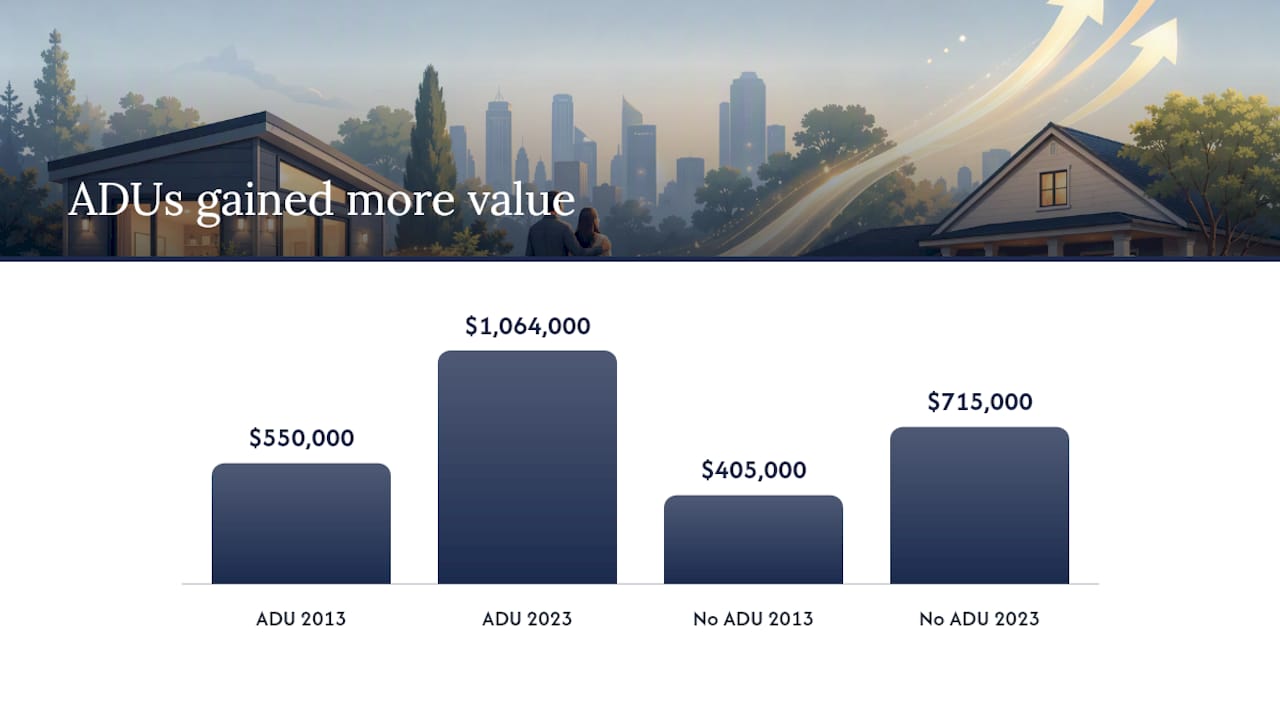
- Permitted ADUs in California showed median appraised values rising from $550,000 to $1,064,000 between 2013 and 2023, outpacing properties without ADUs ($405,000 to $715,000)
That uplift means a thin-cash-flow ADU can still be a smart move if you’re planning to sell within a decade. The resale impact often outweighs a few slow years of monthly income.
What Should Your ADU Payback Checklist Include?
Before you trust any online calculator, collect these inputs yourself: all-in build cost with contingency, three local rent comps, realistic vacancy percentage, full operating expense list, and exact financing terms.
- Run a base case with your real numbers.
- Run a downside case: rent 15% lower, cost 15% higher.
- Run an upside case with faster lease-up and no rate hikes.
Pro Tip: Most free calculators skip permit timeline, tax reassessment at sale, and repair capex. Add a line for each. Missing these can shift real payback by 6 to 18 months.
How Long Does It Take from Decision to First Rent Check?
Garage and basement conversions typically take 3 to 9 months from permit application to a tenant moving in. Prefabricated detached units run 4 to 9 months. Fully custom detached builds often stretch 9 to 18 months once you count design, permitting, and construction. Every month of delay adds carrying costs, interest, insurance, contingency, that push your payback clock out before it even starts.
- Choosing a prefab building kit shortens design and construction time significantly versus custom builds
- Requesting an early permit checklist from your local jurisdiction (Miami-Dade’s ADU guidance page is a good example of what to look for) avoids costly mid-project surprises
The LiveLarge™ Take: How We Advise Clients on ADU Payback
Live Large™ tells clients to treat payback period as a decision filter, not a final answer. If you’re planning to sell within seven years, a conversion almost always wins. It’s cheaper, faster to permit, and the appraisal uplift alone often justifies the cost even before rent income is counted.
For a detached unit, we generally advise against moving forward unless projected payback lands under nine years, or there’s a clear, comp-backed case for appraisal uplift that changes the long-term math. A property that looks marginal on cash flow alone can still be the right move once you factor in what it does to your home’s value at sale.
Where clients get into trouble is skipping the operating expense line items, then wondering why year-one cash flow doesn’t match the spreadsheet. Run the downside case before you sign a construction contract, not after.
— Rudy
Get a Tailored ADU Payback Analysis from Live Large™
Live Large™ builds the model most calculators can’t: one that accounts for your specific build cost, local rent comps, financing terms, and depreciation strategy, not generic city averages.
Live Large™ handles the parts that actually move your payback number: detailed financial modeling before you commit to a design, HELOC and refi guidance so you finance on terms that fit your cash flow goals, turnkey permitting and construction so timelines don’t slip, and optional property management once your ADU is leased. If you’re weighing a conversion against a detached build, the turnkey development model walks through how the process works from contract to move-in. Request a tailored payback analysis from Live Large™ and get real numbers for your property, not a national average.
Sources
- Trends in median appraised value for properties with accessory dwelling units in California
- ADU ROI & Rental Income Calculator