
The fastest way to find tiny house listings in the U.S. is to search Tiny House Listings, Tiny House Society, Facebook Marketplace, Craigslist, and Zillow or Redfin for MLS-sourced small homes. That covers a large majority of the active market. The catch: if your parcel has zoning complexity, needs foundation work, or requires permit coordination, a turnkey ADU development model from a design-build provider like Live Large™ will save you more time and money than hunting listings ever will.
Here’s the quick decision split:
- Buy a listed tiny home when zoning is confirmed, the site is ready, and delivery logistics are straightforward.
- Go turnkey ADU when you need permits pulled, a foundation poured, financing structured, or a single vendor accountable from design to move-in.
Pro Tip: Before you contact a single seller, call your local planning department and confirm the parcel’s allowable dwelling type. That one call eliminates most dead-end listings.
Table of Contents
- Where can you find tiny house listings in the U.S.?
- What should you check in a listing before contacting the seller?
- What zoning and utility checks must you run before placing a tiny home?
- What do tiny homes cost, and how do you finance one?
- When does a turnkey ADU beat buying a listed tiny home?
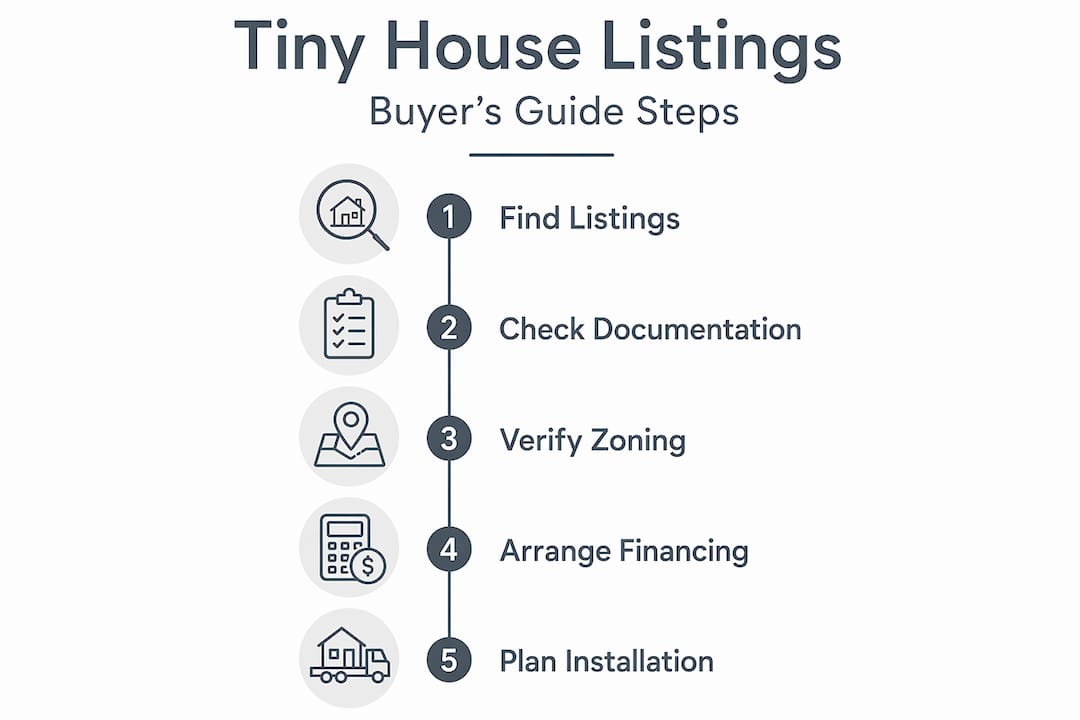
- What does the buying and installation timeline look like?
- Key Takeaways
- Why turnkey ADUs are winning with homeowners right now
- Live Large™ handles the complexity so you don’t have to
- Useful sources and tools to keep on file
Where can you find tiny house listings in the U.S.?
The market splits into four tiers, each with different documentation depth and seller accountability.
Niche listing platforms are the highest-signal starting point. Tiny House Listings and Tiny House Society both aggregate seller-posted units with photos, specs, and price. Tiny House Society often shows NOAH or RVIA certifications directly in the listing headline, which tells you the unit was built to a recognized standard. Tiny Home Builders’ marketplace lets you filter by state and foundation type.
Mainstream real-estate portals like Zillow and Redfin occasionally surface small homes through MLS pulls. These listings tend to include lot data, utility system details, and permit history because licensed agents are involved. A Coldwell Banker MLS listing for an off-grid tiny home, for example, documented a solar array, water storage capacity, and an expansion pad — the kind of detail that rarely appears on a classified ad.
Facebook Marketplace and Craigslist move volume but carry more risk. Sellers are private parties, documentation is inconsistent, and pricing often omits delivery. These channels are worth checking for local deals, but plan to do more vetting work.
Developer and community pages are underused. Some tiny home communities sell units directly with site-ready lots, utility hookups already in place, and community rules that simplify permitting. For investors, this is often the cleanest path to a placed, income-producing unit.
Pro Tip: On any listing, the headline phrase “delivery included” is worth more than a significant price discount. Delivery and setdown on a towable unit can vary substantially depending on distance and site access.
Statistic to note: Tiny homes listed on niche platforms frequently carry NOAH or RVIA certification — a signal that the unit was built to a third-party safety standard, which matters for financing and insurance eligibility.
What should you check in a listing before contacting the seller?
Spend five minutes on these before you pick up the phone.
- Confirm the type. On-wheels (towable) vs. on-foundation changes everything: title transfer, financing options, zoning classification, and utility hookup requirements all differ.
- Check for a VIN or serial number. A towable tiny home should have a VIN. No VIN means potential title problems and difficulty registering with the DMV.
- Look for certification. NOAH, RVIA, or THIA certification signals third-party construction review. Uncertified units may not qualify for specialty financing or insurance.
- Find the delivery line item. If the listing price doesn’t mention delivery, assume it’s not included and budget accordingly.
- Request the permit history. For on-foundation units, ask for prior municipal approvals. For towable units, ask for the title and current DMV registration.
- Ask for an independent inspection. A pre-purchase inspection by a licensed inspector — not the seller’s contractor — is non-negotiable on any unit above $30,000.
A luxury move-in-ready listing in Freeport, Florida illustrates what a well-documented listing looks like: A move-in-ready listing demonstrating high documentation standards with certification, electric grid connection, propane appliances, and washer/dryer included. That’s the documentation standard to hold every listing to.
Pro Tip: If a seller won’t allow an independent inspection or can’t produce a clear title, walk away. Those two refusals together are the single most reliable red flag in the pre-owned tiny home market.
What zoning and utility checks must you run before placing a tiny home?
Zoning regulations are the most common reason a purchased tiny home never gets placed. Municipal codes vary significantly by county and city, and misclassification causes failed placements.
Run these checks before you finalize any purchase:
- Confirm the parcel’s allowable dwelling types. ADU, park model RV, on-foundation small home, and accessory structure each fall under different rules. Ask the planning department specifically which classification applies to your intended unit.
- Ask about setbacks, maximum ADU size, and parking requirements. Many municipalities cap ADU square footage or require a dedicated parking space.
- Verify whether on-wheels units are permitted long-term. Some jurisdictions allow temporary placement only; others prohibit it entirely on residential parcels.
- Check utility connection requirements. Grid connection availability, septic vs. sewer hookup, meter installation, and who pays for trenching all affect your total project cost.
The SEH zoning guide recommends confirming both zoning classification and utility infrastructure before finalizing any purchase. The Gridwise Living zoning checklist provides a ready-made set of questions to bring to your planning and building departments.
Pro Tip: Call three offices: planning/zoning, the building department, and the utility provider. Each controls a different approval, and none of them will volunteer information the others hold.
Key regulatory fact: Municipal codes vary significantly by county and city. A unit that’s perfectly legal in one zip code may be prohibited two miles away.
What do tiny homes cost, and how do you finance one?
The market spans a wide range. A 264 sq ft custom towable unit lists at $48,500 with standard RV hookups. A luxury move-in-ready tiny home example in Freeport, Florida, featuring 325 sq ft, grid-tied electric, NOAH safety certification, and washer/dryer included, demonstrates the higher end of the price spectrum. MLS-listed small homes with lot and utility systems documented can reach a wide price range depending on location and finish level.
Budget beyond the purchase price:
- Delivery and setdown: variable cost for towable units depending on distance and site access
- Foundation or concrete pad: moderate to substantial cost for on-foundation placement
- Utility hookups and trenching: cost varies depending on proximity to grid and sewer
- Permit fees: fees vary widely depending on municipality
- Independent inspection: $300–$600
| Cost Component | Towable Unit | On-Foundation / ADU |
|---|---|---|
| Purchase price | ranges widely for towable and on-foundation units | |
| Delivery & setdown | variable cost for towable units | often included or not applicable for on-foundation units |
| Foundation / site prep | costs depend on project complexity | |
| Utility hookups | costs depend on site conditions and utility availability | |
| Permits | costs vary by locality and project scope |
Financing paths by unit type:
- Towable tiny homes: RV loans or specialty tiny-home lenders; personal loans for lower-priced units. Traditional mortgages rarely apply.
- On-foundation ADUs: HELOC, home equity loan, renovation loan (FHA 203k), or construction loan. These carry lower rates and longer terms than personal loans.
- Investor-scale projects: Private equity, bridge loans, or developer financing. Investors evaluating scalability across multiple units should model financing at the portfolio level, not per unit.
Rental demand is real. Platforms like GlampingHub and even Homes & Villas by Marriott list tiny homes as hospitality products, which gives investors a benchmark for short-term rental income potential before committing to a purchase.
When does a turnkey ADU beat buying a listed tiny home?
Buying a listing makes sense when the site is ready, zoning is confirmed, and the unit is certified and documented. When any of those conditions are missing, the math usually shifts toward a turnkey provider.
Quick comparison:
- Listed tiny home: You source the unit, coordinate delivery, hire a foundation contractor, pull permits yourself, and manage inspections. Timeline: 3–12 months, highly variable.
- Turnkey ADU package: Design, permitting, construction, delivery, and installation are bundled under one contract. Timeline: more predictable, with a single point of accountability.
Consider a homeowner who finds an affordable listing but discovers the parcel requires a variance, a new septic connection, and a concrete pad. Coordinating three separate contractors while managing permit timelines adds months and budget uncertainty. A turnkey provider handles that entire sequence.
Live Large™ bundles site feasibility review, design, permitting assistance, HELOC guidance for homeowners, modular construction, delivery, installation, and optional property management for investors. For investors focused on exit options and ROI, units delivered on foundation in a permitted configuration generate income faster than towable units still waiting on site development.
Pro Tip: Ask any turnkey provider for a written scope that itemizes permitting, foundation work, utility connections, and warranty terms separately. A single lump-sum quote with no line items is a negotiating disadvantage, not a simplification.
Turnkey ADU packages often deliver faster time-to-income for investors because permitting and installation are coordinated in a single process, cutting the friction and unknowns that come with sourcing a listing and then managing site work independently.
What does the buying and installation timeline look like?
| Phase | Typical Duration | Key Tasks |
|---|---|---|
| Search & shortlist | 2–6 weeks | Platform searches, listing vetting, seller contact |
| Due diligence | 1–3 weeks | Inspection, title/VIN check, zoning confirmation |
| Purchase & escrow | 1–2 weeks | Contract, deposit, title transfer |
| Permitting | 2–12 weeks | Application submission, municipal review |
| Site prep | 2–6 weeks | Foundation/pad, utility trenching, meter installation |
| Delivery & setdown | 1–3 days | Transport, crane or forklift setdown, connection |
| Final inspection & move-in | 1–2 weeks | Certificate of occupancy or final sign-off |
Step checklist:
- Confirm zoning and utility feasibility before making an offer.
- Order an independent inspection and request all title/VIN documents.
- Open escrow with a holdback for any unresolved inspection items.
- Submit permit application immediately after purchase closes.
- Hire licensed contractors for foundation, utility, and hookup work.
- Confirm the delivery window in writing with the seller or builder.
- Schedule final inspection with the building department before occupancy.
Red flags that should pause a deal: no written delivery quote, missing permit history, seller refusing independent inspection, or a VIN that doesn’t match DMV records. If sourcing land is also part of your project, run that search in parallel with permitting, not after.
Pro Tip: Permitting is almost always the longest phase. File the application the same week escrow closes — waiting until site prep is done adds 6–10 weeks to your timeline for no reason.
Key Takeaways
Buying a listed tiny home is practical when zoning is confirmed and the unit is documented; a turnkey ADU from a provider like Live Large™ is the stronger choice when permits, foundation work, or financing need coordinating.
| Point | Details |
|---|---|
| Start with niche platforms | Tiny House Listings, Tiny House Society, and Tiny Home Builders offer the most documented listings. |
| Verify title and zoning first | Confirm VIN/title for towable units and parcel zoning before making any offer. |
| Budget total project cost | Delivery, site prep, hookups, and permits can add $10,000–$50,000 beyond the purchase price. |
| Financing depends on unit type | Towable units use RV or personal loans; on-foundation ADUs qualify for HELOC and construction loans. |
| Live Large™ for complex projects | Live Large™ bundles design, permitting, HELOC guidance, construction, and installation in one contract. |
Why turnkey ADUs are winning with homeowners right now
The conventional wisdom says buying a pre-owned tiny home is the affordable path. In practice, that’s only true when the site is already prepared and zoning is clean. Most residential parcels in the U.S. aren’t in that condition, and the gap between a listing’s purchase price and its actual placed-and-liveable cost surprises buyers repeatedly.
What’s shifted is that turnkey ADU providers have gotten genuinely good at bundling the hard parts. Permitting used to be the bottleneck that made design-build feel slow. Now, providers who have built relationships with local planning departments and standardized their permit packages move faster than most buyers can coordinate independently. The financing piece has also matured: HELOC-based funding for homeowners is a well-worn path, and investors who understand urban infill development are increasingly treating turnkey ADU packages as the lower-risk entry point compared to assembling a project from a listing outward.
The listing market is real and worth searching. But for anyone whose parcel needs work, the math on turnkey ADUs closes faster than most people anticipate.
Live Large™ handles the complexity so you don’t have to
Searching tiny homes for sale is a reasonable starting point. But if your site needs a feasibility review, permits pulled, a foundation built, or financing structured, Live Large™ is the direct alternative to managing that yourself.
Live Large™ bundles every phase of an ADU project under one contract: site feasibility, design, permitting assistance, HELOC guidance for homeowners, modular construction, delivery, installation, and optional property management for investors building a rental portfolio. Readers in Florida can review Tampa’s current ADU policy reforms for local context before reaching out. When you’re ready to move from searching listings to having a unit placed and income-producing, start with a feasibility conversation with the Live Large™ team.
Useful sources and tools to keep on file
Listing platforms to monitor:
- Tiny House Listings — largest U.S. niche listing database; filter by state and type
- Tiny House Society — seller-posted listings with certification labels
- Tiny Home Builders Marketplace — state-filtered listings with foundation-type detail
- Little Houses For Sale — affordable towable listings with specs
- Zillow and Redfin — MLS-sourced small homes with lot and utility data
Zoning and regulatory resources:
- WVU Land Use — Tiny Homes Factsheet — land-use classification overview for tiny homes
- SEH Zoning for Tiny Homes — pre-purchase zoning due diligence guide
- Gridwise Living 2026 Zoning Checklist — ready-to-use question list for planning and building departments
Municipal contact template (copy and use when calling):