
The income approach converts your ADU’s expected rental cash flow into a contributory value using one core formula: Value = NOI ÷ cap rate. Net Operating Income (NOI) is what’s left after you subtract vacancy allowances and operating expenses from gross rent. Divide that by a market-derived capitalization rate, and you get a dollar figure representing what the ADU adds to your property’s appraised value. When a discounted cash flow (DCF) analysis is warranted, appraisers project income over a holding period and discount it back to present value, but for most ADU assignments, direct capitalization is the method you’ll see.
This approach applies when your ADU is legally permitted and either currently rented or clearly rentable. It does not apply to owner-occupied units with no rental history, unpermitted structures, or ADUs in markets lacking verifiable rent data. Per the Appraisal Foundation’s USPAP and Fannie Mae guidance, appraisers must first confirm legality and test Highest & Best Use before developing the income approach at all.
- The formula: Value = NOI ÷ Cap Rate
- NOI = Gross potential rent minus vacancy minus operating expenses
- Applies to: legally permitted, rentable ADUs with market rent support
- Does not apply to: owner-occupied, unpermitted, or rent-comp-scarce situations
Table of Contents
- What is the income approach in an ADU appraisal?
- Key appraisal terms you’ll encounter in income approach reports
- Benefits and limitations of the income approach for ADUs
- How does the income approach compare to other ADU appraisal methods?
- Worked example: converting ADU rent into contributory value
- When should appraisers not rely on the income approach for an ADU?
- What documentation should you give the appraiser?
- Where do cap rates come from, and how do appraisers justify them?
- ADU ROI perspective: connecting appraisal value to real returns
- Key Takeaways
- The part most homeowners get wrong about ADU appraisals
- Live Large™ helps you prepare for an income-based ADU appraisal
- Authoritative sources and further reading
What is the income approach in an ADU appraisal?
Appraisers follow a specific sequence when applying the income approach to an ADU. Each step builds on the last, and skipping one typically produces a value that won’t hold up under lender or underwriter review.
-
Confirm legality and Highest & Best Use (HBU). Before running any numbers, the appraiser verifies the ADU is legally permitted and checks whether both the main house and the ADU can be rented simultaneously. Per practitioner guidance, this HBU determination often decides whether the income approach gets developed at all.
-
Estimate potential gross rent. The appraiser surveys comparable rentals in the local market to establish a market rent for the ADU. This is the gross potential rent, the ceiling before any deductions.
-
Subtract vacancy and collection loss. A vacancy and credit loss allowance (a market-derived deduction reflecting realistic downtime between tenants and occasional non-payment) accounts for periods the unit sits empty or rent goes uncollected.
-
Subtract operating expenses. Insurance, property tax allocation, maintenance, and any management fees come off next. What remains is NOI.
-
Select a capitalization rate or decide on DCF. For most ADU assignments, appraisers use direct capitalization. DCF is reserved for situations where income is expected to change materially over time, such as a lease with scheduled rent increases or a phased renovation.
-
Apply the formula. NOI ÷ cap rate = contributory value for the ADU.
-
Reconcile with other approaches. The income result rarely stands alone. Appraisers weigh it against the sales-comparison and cost approaches before arriving at a final opinion of value.
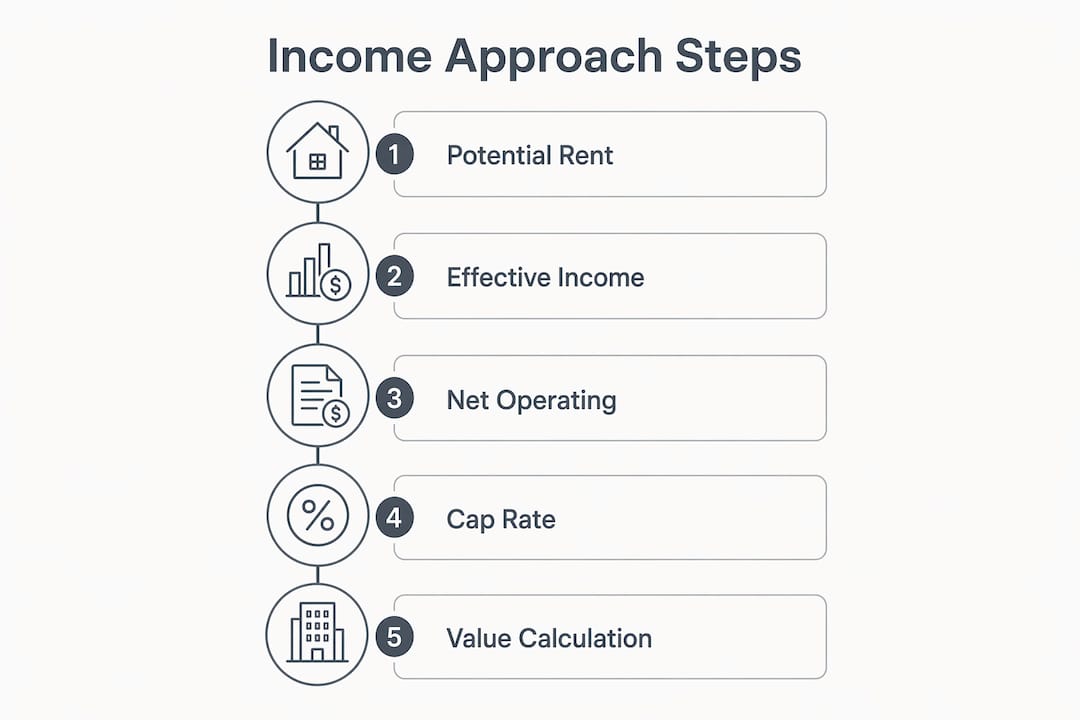
The income stream flows like this: Potential gross rent → Effective gross income → NOI → Value = NOI ÷ cap rate. Effective gross income is simply potential gross rent minus the vacancy allowance, before operating expenses.
Pro Tip: Run the HBU check before you order the appraisal. If your municipality requires owner-occupancy of either unit, the income approach may carry little weight, and you’ll pay for a more complex appraisal scope without the benefit.

Key appraisal terms you’ll encounter in income approach reports
Reading an appraisal report is easier once you know what each line item actually does to the final number. Here are the terms that matter most for an ADU income analysis.
- Potential gross rent (PGR): The annual rent the ADU would generate at 100% occupancy. This is the starting point, not the value driver.
- Vacancy and credit loss: A market-derived deduction, often 5%–10% of PGR, reflecting realistic downtime between tenants and occasional non-payment.
- Effective gross income (EGI): PGR minus vacancy. Formula: EGI = PGR × (1 – vacancy rate).
- Operating expenses: Insurance premiums, property tax allocation, and management fees are the main categories for an ADU. Gross rent alone overstates attractiveness; net income determines value.
- Net Operating Income (NOI): EGI minus operating expenses. This is the number you divide by the cap rate to get value. See a deeper breakdown at Live Large™’s guide to ADU net operating income.
- Capitalization rate (cap rate): The ratio of NOI to value, extracted from comparable investment property sales. A higher cap rate means a lower value for the same NOI. If NOI is $12,000 and the cap rate is 6%, value = $200,000. At 8%, that same NOI yields $150,000.
- Gross rent multiplier (GRM): A simpler alternative. GRM multiplies annual gross rent by a market-derived factor. GRM is faster but less precise than direct capitalization when expense data are available.
- Discount rate: Used in DCF analysis. Reflects the investor’s required return over a projection period, accounting for the time value of money.
- Reversion value: The estimated resale value at the end of a DCF projection period, discounted back to present value.
The cap rate is the most sensitive variable in the whole model. Small changes in the cap rate on a given NOI change the indicated value by tens of thousands of dollars.
Benefits and limitations of the income approach for ADUs
Where the income approach adds real value
- Objective and investor-focused. It ties value directly to cash flow, which is what an investor buyer actually cares about.
- Useful for refinancing. Lenders increasingly recognize ADU rental income. In high-rent markets like the Bay Area, appraisers report greater reliance on the income approach for ADU valuations, and 2026 lender rule changes have expanded how much ADU income lenders can count toward mortgage qualification. See how this affects ADU rental portfolio refinancing.
- Defensible when data are strong. A current lease, comparable rental listings, and documented expenses give the appraiser everything needed to justify NOI and the cap rate.
- Portfolio valuation. For investors holding multiple ADUs, the income approach provides a consistent framework across properties.
Where it falls short
- Sensitive to cap rate selection. Small changes to cap rate or NOI dramatically alter the value estimate, which means a poorly supported cap rate can swing the result by tens of thousands of dollars.
- Requires verifiable data. Without solid rent comps and documented expenses, the approach loses credibility fast.
- Not appropriate for owner-occupied or unpermitted units. An ADU the owner lives in has no income stream to capitalize. An unpermitted unit may receive zero contributory value, and in some cases an appraiser may assign negative value to account for demolition or compliance costs.
- Thin markets undermine it. When rental data are scarce or unreliable, appraisers typically lean on the sales-comparison approach instead.
Appraisers rarely rely on the income approach alone. In most ADU assignments, they reconcile the income result with the sales-comparison and cost approaches, weighting each based on the quality of available data.
Red flags that weaken income approach reliability: thin or nonexistent rent comps, unusual zoning restrictions, owner-occupancy requirements, unpermitted ADU status, and atypically low rents due to size or finish level.
How does the income approach compare to other ADU appraisal methods?
| Approach | Best use for ADUs | Main limitation |
|---|---|---|
| Income approach | Rented or clearly rentable, permitted ADUs with market rent support | Sensitive to cap rate; requires verifiable expense and rent data |
| Sales comparison | Most ADU assignments; suburban markets with comparable sales | Comparable sales with ADUs can be scarce in some markets |
| Cost approach | New or recently built ADUs; markets with few sales or rent comps | Depreciation estimates can be subjective; ignores income potential |
In practice, appraisers weigh these results based on what the market supports. In a suburban neighborhood where ADUs are common but rarely rented, the sales-comparison approach usually dominates. In a high-rent urban market where investors actively buy properties for their ADU income, the income approach carries more weight. Permit status and legal occupancy rules are the deciding factor in borderline cases: a legally nonconforming ADU often gets zero weight under the income approach regardless of actual rent collected.
For homeowners in markets undergoing zoning reform, understanding what qualifies as a rental ADU is the first step before expecting any income-based contributory value.
Worked example: converting ADU rent into contributory value
Here’s a concrete example using a 500-square-foot detached ADU in a mid-sized U.S. market. These are illustrative assumptions, not market guarantees.
| Assumption | Amount |
|---|---|
| Insurance allocation | ($600) |
| Maintenance reserve | ($600) |
| Net Operating Income (NOI) | $14,640 |
| Cap rate applied | |
| Indicated contributory value | $225,231 |
The math: $14,640 ÷ 0.065 = $225,231.
Sensitivity: how cap rate and vacancy shift the result
| Scenario | NOI | Cap Rate | Indicated Value |
|---|---|---|---|
| Base case | $14,640 | 6.5% | $225,231 |
| Cap rate rises | $14,640 | 7.5% | — |
| Cap rate falls | $14,640 | 5.5% | — |
| Vacancy rises | — | 6.5% | — |
A single percentage point in the cap rate moves the indicated value by roughly $30,000–$40,000 on this NOI. That’s why cap rate selection is the most contested part of any income-based ADU appraisal.
Pro Tip: Document every assumption with a source. Pull rent comps from current local listings, get an insurance quote specific to the ADU, and ask your accountant for a property tax allocation. An appraiser who can trace each line item to a real source is far more likely to defend the income approach under lender review.
When should appraisers not rely on the income approach for an ADU?
Not every ADU warrants an income-based valuation. These are the situations where the approach should be set aside or given minimal weight.
- Owner-occupied ADU with no rental history or clear rental ability. If the owner lives in the ADU and there’s no evidence the market supports renting it, there’s no income stream to capitalize.
- Unpermitted or illegal ADU. Appraisers cannot capitalize income from a unit that legally cannot be rented. Unpermitted units often receive zero contributory value, and compliance costs can push the number negative.
- Markets with no rent comparables. Without verifiable local rent data, any NOI estimate is speculative. The income approach loses weight when the appraiser cannot support the gross rent figure with market evidence.
- Extremely short anticipated useful life. A temporary or deteriorating structure with a short remaining economic life doesn’t produce a reliable long-term income stream.
- ADU sized or finished in a way that rents atypically low. A 200-square-foot studio in a market where studios rent for $600/month produces an NOI that may not justify the income approach over simpler methods.
If you want to strengthen the case for an income-based valuation, gather actual lease agreements, show a documented rental history, and demonstrate local rent demand with current listings. The more evidence you hand the appraiser, the more defensible the income approach becomes.
What documentation should you give the appraiser?
Appraisers rely on owner-supplied documentation to justify every line in the income analysis. Proactively supplying leases, rent schedules, and expense invoices gives the appraiser the raw material to develop a credible income approach.
- Proof of permits and certificate of occupancy. Without these, the income approach is off the table.
- Current lease or rental history. A signed lease is the strongest evidence of market rent. If the unit is vacant, provide prior leases.
- Comparable rental listings. Pull three to five current listings for similar units in your area. Zillow, Apartments.com, and local property management reports are common sources. For a deeper look at analyzing comparable rentals, use a structured comparison framework.
- Insurance quote or policy showing ADU-specific premium. Appraisers need the incremental cost, not the whole homeowner’s policy.
- Property tax allocation estimate. Ask your tax advisor or use the assessed value ratio of the ADU to the total property.
- Itemized maintenance and management expense support. Invoices, contracts, or reasonable estimates with a source.
- Photos and floor plan showing separate entrance and independent facilities. These confirm the ADU functions as a self-contained rental unit.
For shared expenses between the main house and the ADU, appraisers typically accept a square-footage-based allocation. Divide the ADU’s square footage by total improved square footage on the lot, then apply that ratio to shared costs like landscaping or shared utilities.
Where do cap rates come from, and how do appraisers justify them?
Cap rates for ADUs don’t come from a published table. Appraisers derive them from the market, and the derivation process is worth understanding because it’s where the most disagreement happens.
- Extraction from comparable sales. The preferred method: find recent sales of small rental properties (duplexes, small multi-family, or single-family homes with confirmed rental income), divide each property’s NOI by its sale price, and develop a range of overall rates. This is called the market-derived rate, and it’s the most defensible approach when comparable sales exist.
- Market surveys and investor interviews. When comparable sales are thin, appraisers may reference published cap-rate surveys for the local submarket or interview active investors about their return expectations.
- Band-of-investment method. Appraisers can also derive a cap rate by weighting the cost of debt and equity capital. This is more common for larger commercial properties but occasionally appears in ADU reports.
The limitation for ADUs specifically is that most single-family neighborhoods don’t have a deep pool of small-rental comparable sales. An appraiser extracting a cap rate from two or three sales is working with a thin sample, and a motivated buyer or seller can reasonably challenge the result. Understanding high-demand rental market conditions in your area helps you evaluate whether the appraiser’s cap rate reflects current investor behavior.
Small cap-rate differences compound quickly. On a $14,640 NOI, moving from 6% to 7% drops the indicated value by about $35,000. That’s not a rounding error; it’s the difference between a refinance that works and one that doesn’t.
ADU ROI perspective: connecting appraisal value to real returns
Understanding the income approach isn’t just an appraisal exercise. It’s how you evaluate whether building or buying an ADU makes financial sense.
| Scenario | ADU construction cost | Indicated contributory value | Estimated annual NOI | Cash-on-cash return |
|---|---|---|---|---|
| Base case (6.5% cap) | $150,000 | $225,231 | $14,640 | — |
| Conservative (7.5% cap) | $150,000 | — | $14,640 | — |
| Strong market (5.5% cap) | $150,000 | — | $14,640 | — |
Cash-on-cash return stays constant because it’s based on actual NOI relative to construction cost, not the appraised value. The appraised value matters for refinancing and sale; the cash-on-cash return matters for ongoing investment performance. See Live Large™’s ADU investment return examples for a broader breakdown of how construction costs and market conditions interact.
One thing cost-vs-value research consistently shows: high-end finishes in small ADUs rarely return their full cost in appraised value. A granite countertop in a 400-square-foot unit doesn’t move the rent needle enough to justify the premium. Functional upgrades, an additional bedroom, a dedicated parking space, or a separate entrance, tend to produce better contributory value per dollar spent.
Practical action items for homeowners and investors:
- Tell the appraiser about the ADU when ordering the appraisal. Most single-unit residential appraisals don’t involve the income approach by default; if you want it considered, say so upfront and expect a higher appraisal fee.
- Collect and vet rent comps before the appraisal appointment. Three to five current listings for comparable units in your zip code, pulled within 90 days, give the appraiser a defensible gross rent figure.
- Ask for a DCF analysis only when your income is projected to change materially, such as a lease with scheduled rent increases or a planned renovation that will push rents higher. For stable, market-rate ADUs, direct capitalization is simpler and equally defensible.
- Check your ADU rental income potential against local market data before assuming the income approach will add significant value.
Key Takeaways
The income approach produces a defensible ADU contributory value only when the unit is legally permitted, actively rented or clearly rentable, and supported by verifiable rent comps and documented operating expenses.
| Point | Details |
|---|---|
| Core formula | Value = NOI ÷ cap rate; NOI equals gross rent minus vacancy and operating expenses. |
| Legality comes first | An unpermitted ADU cannot be capitalized; confirm permits and certificate of occupancy before the appraisal. |
| Cap rate sensitivity | A one-point cap rate change on a $14,640 NOI shifts indicated value by $30,000–$40,000. |
| Documentation wins | Leases, rent comps, and itemized expense support give appraisers what they need to defend the income approach. |
| Live Large™ next step | Live Large™ helps homeowners prepare permits, NOI schedules, and rent comps to support an income-based ADU appraisal. |
The part most homeowners get wrong about ADU appraisals
The most common mistake is expecting the income approach to reward spending. Owners pour money into premium finishes, assuming the appraiser will reflect that cost in contributory value. They won’t, at least not dollar for dollar. Appraisers capitalize income, not construction invoices. If the finishes don’t move the rent, they don’t move the value.
The second mistake is showing up to the appraisal empty-handed. An appraiser who has to build the rent schedule from scratch, without a lease, without comps, without expense documentation, will either skip the income approach entirely or produce a conservative estimate that undersells the ADU. The owners who get the strongest income-based valuations are the ones who hand the appraiser a folder: current lease, three comparable listings pulled that week, an insurance quote, and a property tax allocation memo.
One tip that consistently makes a difference: call the appraiser before the inspection and walk them through the ADU’s rental history. A five-minute conversation about actual rent collected, vacancy periods, and operating costs gives the appraiser context that a folder alone doesn’t provide. It also signals that you understand the process, which tends to result in a more thorough income analysis.
Live Large™ helps you prepare for an income-based ADU appraisal
Getting the income approach to work in your favor starts well before the appraiser arrives. Live Large™ helps homeowners and investors pull together the documentation that makes an income-based valuation defensible: permit verification, rent-comparable research, NOI schedules, and expense allocation support. That preparation increases the likelihood an appraiser will develop the income approach and give your ADU the contributory value it’s earned.

If you’re in a market where ADU policy is shifting fast, like Tampa’s recent ADU reforms or Pasco County’s new ADU approvals, getting the permitting right from the start is what separates an ADU that appraises well from one that gets zero contributory value. Live Large™ works through the full process: purchase, financing, development, construction, and installation, so your ADU is built to be both rentable and appraisal-ready. Ready to get started? Contact Live Large™ to schedule a consultation and find out what your ADU could be worth.
Authoritative sources and further reading
- A Practitioner’s Guide to Appraising ADUs: Supports the HBU confirmation step, legality checks, and documentation checklist sections.
- The Income Approach to Value (California BOE): Supports the core formula, cap rate sensitivity discussion, and the definition of the income approach.
- McKissock Learning: What Is the Income Approach to Appraisal?: Supports the NOI formula, cap rate application, and the section on when market data are thin.
- LegalClarity: How Is ADU Value Calculated?: Supports the GRM vs. direct cap comparison and the operating expense discussion.
- Pacific Appraisers: How an Appraiser Values Your Backyard ADU: Supports the market-variation section and the 2026 lender rule change context.
- JLC Online: Cost vs. Value 2026: Supports the perspective on luxury finishes and the ROI discussion.
- Live Large™: ADU Rental Income Potential: Guidance on sourcing and verifying rental income data for NOI calculations.