
The fastest way to fail at small home development land sourcing is to start with a property listing. The developers who consistently find viable parcels start earlier, look in different places, and vet sites before they ever make an offer. Sourcing land for small residential projects means locating parcels that align with zoning codes, infrastructure realities, and your specific project goals, then moving quickly enough to act before competition drives up the price.
Before you search a single listing, get clear on your criteria:
- Target acreage: Most viable small home communities start with a few acres of raw land, enough for shared infrastructure and density efficiency.
- Zoning compatibility: Look for parcels zoned for multifamily, cluster housing, or Planned Unit Development (PUD), or those in jurisdictions with recent pro-housing reforms.
- Infrastructure access: Water, sewer, and road access dramatically affect your development budget.
- Market context: Understand local planning department capacity, recent zoning changes, and comparable land values before committing to a submarket.
- Project exit: Decide upfront whether you plan to build and sell, subdivide and sell lots, or hold for rental income.
How to find the right land for small home development
The MLS is the wrong starting point. Developers who rely solely on MLS miss the most impactful deals, which surface through direct owner outreach, attorney networks handling probate and distressed sales, and contractor referrals. By the time a parcel hits a public listing, competing buyers have already driven up the price.
Off-market sourcing is a relationship business. In markets like Austin, early broker-builder relationships give developers access to pre-list parcels and teardown candidates before they become competitive. The same principle applies in any metro with active infill development.
Practical sourcing channels to work simultaneously:
- Specialized vacant land marketplaces with filters for acreage, zoning type, and owner-financed options.
- Direct owner outreach using county land records to identify owners of underutilized parcels that match your criteria.
- Attorney networks for estate, probate, and distressed-owner inventory that never reaches MLS.
- Land assemblies: Adjacent parcels that individually fall short can be combined for larger projects, though this requires coordinating multiple owners and legal expertise.
- Broker relationships built before you have a project, not after.
Proximity to transit, walkable amenities, and existing utility infrastructure should all factor into your site selection criteria. A parcel priced $30,000 below market often carries $60,000 in utility extension costs.
Checking feasibility before you make an offer
Never buy land without a pre-development meeting with the local planning department. Bring a rough site plan and ask directly about minimum square footage requirements, density limits, and any overlay restrictions. If the jurisdiction requires 1,000 square feet per unit and your project targets 440-square-foot homes, you need to know that before you spend money on due diligence.
Pre-vetting a parcel against a development-viability checklist compresses underwriting time from weeks to days and lets you make competitive offers without extended post-LOI investigation. The checklist should cover:
- Zoning and permitted uses: Current designation, applicable overlays, historic district status, and any deed restrictions that override zoning.
- Buildable envelope: Front, side, and rear setbacks, height limits, and floor-area ratio where applicable.
- Impervious cover ratio: Maximum allowed versus existing coverage on the parcel.
- Easements and encroachments: Utility easements, drainage easements, and recorded access rights that cut through your best building sites.
- Floodplain status: FEMA mapping and any local watershed protections.
- Environmental and soil conditions: Contamination history, soil bearing capacity, and drainage patterns that affect grading costs.
Securing preliminary approvals or rezoning before purchase substantially lowers both financing risk and development cost. It is the single most effective way to de-risk a small lot project.
How to secure zoning approvals and permits for small home projects
Zoning is the absolute filter. Aesthetics, layout, and unit count all come after you confirm the legal use. Recent pro-housing reforms have made this easier in several states, but local codes still vary widely, and planning department capacity is a real constraint.
Planning delays are the most cited barrier for small-scale developers, with inadequate local authority capacity compounding the problem. The practical response is to engage planning officials early and often, not just at application submission.
Key zoning and permitting steps:
- Identify the minimum lot size in your target jurisdiction. Los Angeles’ Small Lot Subdivision Ordinance allows minimum lot widths as low as 16 feet and lot areas as small as 600 square feet, enabling detached townhome development without mandatory HOAs.
- Explore PUD options. A Planned Unit Development lets you propose a custom zoning plan for your specific parcel, bypassing rigid standard rules in exchange for community benefits.
- Check ADU policies. Accessory dwelling unit regulations have expanded significantly in many states, and recent ADU policy reforms can open up development paths that standard zoning would block.
- Understand subdivision map requirements. Small lot subdivisions typically require a tract or parcel map application, maintenance association documentation, and fire department accessibility confirmation.
- Build a relationship with the planning department before you file. Developers who treat planning officials as adversaries consistently face longer timelines.
Pro Tip: Ask the planning department about any pending zoning amendments in your target area. A code update scheduled for six months out can either accelerate or kill your project depending on its direction.
Designing infrastructure and preparing the site for development
Utility installation and infrastructure costs kill margins early in development when they are not evaluated before acquisition. A parcel with existing water and sewer connections is worth a meaningful premium over raw land that requires new utility extensions.
Infrastructure planning for small home sites:
- Utility connections: Confirm water and sewer capacity, not just proximity. A line running 50 feet from your parcel boundary may lack the capacity to serve 10 new units.
- Road access: Building a new road is expensive. Prioritize parcels with existing access, and verify that access meets fire department standards for emergency vehicle clearance.
- Topography and drainage: Steep grades and poor drainage add grading costs and can reduce your buildable area significantly. Review topographic maps before ordering a full survey.
- Shared infrastructure: Cluster housing layouts and tiny home communities benefit from shared utility hubs, central driveways, and common open space, which distribute infrastructure costs across more units.
- Environmental compliance: Clearing and grading permits often trigger stormwater management requirements. Budget for retention or detention systems if your site has significant impervious cover.
For small-scale cluster developments, the urban infill planning approach often yields the best infrastructure-to-unit-count ratio, particularly on infill parcels where utilities are already nearby.
Subdividing, building, or selling after you acquire the land
Once you own an entitled parcel, you have three realistic paths: subdivide and sell lots, build and sell completed homes, or hold and rent. The right choice depends on your capital position, timeline, and local market demand.
Small lot subdivision tends to work best as a build-to-sell strategy. On a 5,000-square-foot corner lot with a minimum lot size of approximately two thousand square feet, a developer can typically increase the unit count compared to conventional single-family zoning. That density math is what makes the numbers work on infill land that would otherwise be too expensive per unit.
Post-acquisition considerations:
- Replat costs: Subdividing a lot into smaller parcels requires a replat filing, survey, and often a title update. Budget for this as a hard cost before construction begins.
- Build vs. sell raw: Selling an entitled parcel to another developer is faster and lower-risk. Building captures more margin but requires construction financing and a longer timeline.
- Resale value: Small home lots in walkable, amenity-rich neighborhoods command strong buyer interest. Buyers accept smaller yards and tighter footprints when the location delivers commute times, schools, or restaurant access they cannot find elsewhere.
- Exit on raw or entitled land: If your project stalls at the permitting stage, an entitled parcel is worth substantially more than raw land. Securing preliminary approval before you need to sell is a built-in exit strategy.
Legal and zoning factors that affect small home development viability
Ownership structure matters as much as zoning designation. Fee-simple ownership, where the buyer owns both the land and the structure, is the most straightforward model and the easiest to finance. Community Land Trusts (CLTs) offer a different path: the trust retains land ownership while the buyer owns the home, lowering upfront costs and keeping units affordable for buyers earning a moderate income level.
Legal factors that routinely derail small lot projects:
- Minimum lot size and setback requirements that make your target unit count mathematically impossible without a variance or rezoning.
- Parking minimums that consume land you need for units. A single garaged parking space requires significant space, which can consume a large portion of the buildable area on very small lots.
- Historic district overlays that restrict exterior design, materials, and sometimes density, even when the underlying zoning permits development.
- Subdivision timeline: In Los Angeles, the small lot subdivision process can take up to a year or longer, making entitlement a significant carrying cost.
- Deed restrictions and CCRs: These can override zoning and block development entirely. Always have a land use attorney review title before you go hard on a contract.
The missing middle housing framework offers useful context for understanding how ownership models and zoning interact in small-scale residential development.
Government initiatives and market trends supporting small home development
The regulatory environment for small home development has shifted meaningfully in the past two years. Cities and states that spent decades restricting density are now actively creating pathways for it.
Key trends and programs worth tracking:
- Pro-housing zoning reforms: Cities like Austin, TX, and states including Minnesota, Maryland, Massachusetts, and California have passed legislation allowing multi-unit developments on lots previously restricted to single-family homes. California’s SB9 allows up to five units on single-family zoned properties; SB684 allows up to ten units on multifamily-zoned land.
- Texas Senate Bill 15 prohibits the state’s largest cities from enforcing minimum lot sizes larger than 3,000 square feet in new subdivisions, a direct benefit for tiny home community developers targeting high-density layouts.
- Open-source architectural plans: Government pilot programs are releasing free design plans for small-footprint homes, ranging from 440 to just over 1,000 square feet, simplifying design approval and reducing soft costs.
- Community Land Trusts: CLT programs like Clark County’s Welcome Home initiative are expanding access to affordable homeownership by separating land from home ownership, keeping units permanently affordable across resale cycles.
- Data-driven site sourcing: Successful developers are combining planning constraint mapping with development expertise to identify overlooked small-scale residential opportunities that purely relationship-based sourcing misses.
The ADU legislative momentum at the state level is creating additional pathways for small home development, particularly for developers working on infill lots in established neighborhoods.
A step-by-step process to source residential land
Consistency beats intensity in land sourcing. A daily 30–60 minute routine focused on planning application reviews, auction monitoring, and zoning updates outperforms sporadic deep-dive sessions.
Step 1: Define your buying criteria. Target submarket, parcel size, current zoning preference, exit strategy, and price range. Without this, every parcel looks like a possibility and none get evaluated properly.

Step 2: Build your sourcing channels. Set up alerts on vacant land marketplaces, establish relationships with attorneys handling estate and probate inventory, and connect with brokers who specialize in your target area before you need them.
Step 3: Run daily monitoring. Review new planning applications, check auction catalogs, and scan new listings in your target submarket every morning.
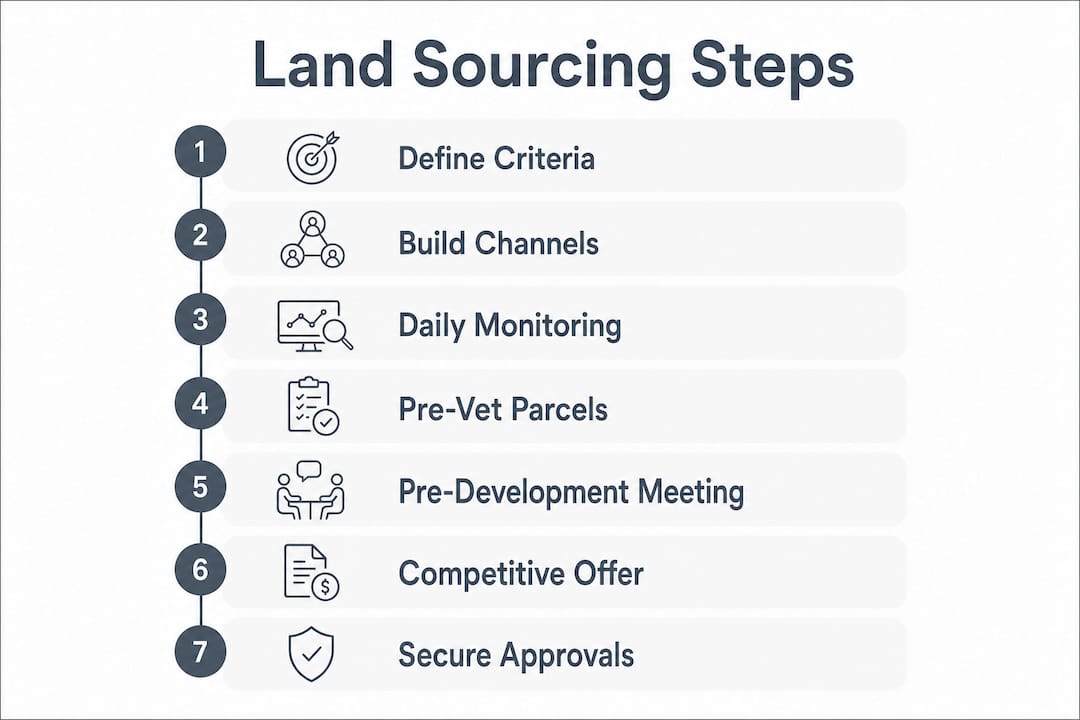
Step 4: Pre-vet before presenting. Check zoning, setbacks, impervious cover, easements, and floodplain status on every parcel before spending time on a site visit or making an offer.
Step 5: Attend a pre-development meeting. Before going hard on a contract, meet with the local planning department. Confirm permitted uses, density limits, and any pending code changes.
Step 6: Make a competitive offer. Pre-vetted parcels let you underwrite quickly and offer confidently. Developers who skip pre-vetting spend weeks on due diligence after an accepted offer, losing deals to faster buyers.
Step 7: Secure preliminary approvals. Work toward entitlement before closing when possible. A parcel with preliminary PUD approval is worth more and easier to finance than raw land.
Financing options and budgeting for land acquisition
Land financing is harder than construction financing. Most conventional lenders treat raw land as high-risk collateral, which means higher down payments and shorter loan terms than you would see on improved property.
Realistic financing paths for small-scale developers:
- Owner financing: Many vacant land sellers will carry a note, often requiring 20–30% down. This keeps your capital liquid for development costs and avoids bank underwriting on raw land.
- Land loans from community banks and credit unions: Local institutions with development lending experience are more likely to underwrite land loans than national banks. Bring a clear development plan and exit strategy.
- Hard money lenders: Short-term, higher-cost capital that works for acquisitions where you plan to entitle and refinance or sell quickly.
- Construction-to-permanent loans: If you plan to build immediately after acquisition, some lenders will combine land and construction financing into a single loan, simplifying the capital stack.
Budget beyond the purchase price. Replat fees, pre-development meeting costs, environmental assessments, survey work, and carrying costs during entitlement all add up before you break ground. Land cost should generally stay around 15–20% of your estimated exit price to keep the project financially viable.
Negotiation strategies that actually work with land sellers
The best negotiation position comes from information the seller does not have. If you know the parcel’s development constraints better than the owner does, you can price those constraints into your offer and justify a lower number with specifics rather than vague lowballing.
Effective approaches:
- Lead with relationship, not price. Off-market sellers often care about who is buying their land and what will be built. A developer with a clear, community-friendly vision can win deals over higher bidders.
- Use contingencies strategically. A feasibility contingency gives you time to complete due diligence without going hard on a contract you cannot underwrite. Sellers who accept contingencies are often more motivated than those who insist on clean offers.
- Offer speed as a value. Pre-vetted buyers who can close in 30 days are worth a discount to sellers who want certainty over maximum price.
- Negotiate seller financing. Owners of unencumbered land often prefer installment income over a lump-sum taxable event. Proposing seller financing can unlock deals that cash offers cannot.
For off-market parcels, understanding how sourcers find deals and structure introductions gives you a clearer picture of what the seller’s expectations are likely to be before you open a conversation.
Due diligence on land titles and liens
Title issues on vacant land are more common than on improved residential property, partly because raw land changes hands less frequently and partly because liens, easements, and encumbrances can sit unnoticed for years. A clean-looking parcel can carry a mechanic’s lien from a contractor who graded the site a decade ago.
Title due diligence checklist:
- Order a preliminary title report as soon as a parcel goes under contract. Review it with a real estate attorney, not just a title officer.
- Check for tax liens and delinquencies. Unpaid property taxes attach to the land, not the prior owner.
- Identify all recorded easements. Utility easements, drainage easements, and access easements can cut through your best building sites and restrict what you can build above or around them.
- Review deed restrictions. Covenants and conditions recorded decades ago can prohibit uses that current zoning permits. These are not always visible in a standard title search.
- Confirm boundary lines. Fence lines and survey monuments do not always match recorded legal descriptions. Order a current survey before closing.
- Verify no pending litigation. A parcel involved in a boundary dispute or estate contest can be tied up for months after you close.
Never waive title insurance on a land purchase. The premium is small relative to the cost of defending a title claim after you have invested in entitlement.
Working with real estate agents and land brokers effectively
Not all real estate agents understand land development. A residential agent who sells single-family homes is not the same as a land broker who understands zoning, entitlement timelines, and development feasibility. The distinction matters more on a land deal than almost any other transaction type.
What to look for in a land broker:
- Submarket specialization. A broker who focuses on your target area knows which parcels are quietly available, which owners are considering selling, and which planning officials are receptive to which project types.
- Development literacy. Your broker should understand HOME eligibility, impervious cover ratios, setback requirements, and overlay restrictions well enough to pre-screen parcels before presenting them to you.
- Attorney and contractor networks. The best land deals come through relationships with estate attorneys and contractors who know which owners are in distress. A broker with these connections is worth more than one who only works MLS.
- Transparent fee structure. For off-market sourcing where there is no listing agent, the developer typically pays a sourcing fee or buyer-side commission directly. Confirm this structure before you start working together.
The optimal time to build a broker relationship is before you have a project to list, not after. Brokers who know your criteria in advance can surface parcels as they emerge, rather than scrambling to find something after you announce you are ready to buy.
Key Takeaways
Successful small home development land sourcing combines off-market relationships, rigorous pre-purchase feasibility checks, and early engagement with planning authorities to find and close on viable parcels faster than the competition.
| Point | Details |
|---|---|
| Start off-market | Direct owner outreach, attorney networks, and broker relationships surface parcels before MLS competition drives up prices. |
| Pre-vet every parcel | Check zoning, setbacks, impervious cover, easements, and floodplain status before making an offer to compress underwriting time. |
| Engage planning early | A pre-development meeting with local officials confirms permitted uses and density limits before you spend money on due diligence. |
| De-risk through entitlement | Securing preliminary approvals before purchase lowers financing risk and increases parcel value for resale or construction. |
| Budget beyond purchase price | Replat fees, environmental assessments, surveys, and carrying costs during entitlement add up before a single unit is built. |
Live Large™ helps you move from land to livable space
Finding the right parcel is only the first step. Live Large™ specializes in the purchase, financing, development, construction, and installation of accessory dwelling units and small-footprint modern homes, giving developers and homeowners a clear path from raw land to finished, livable space. Whether you are navigating ADU zoning reforms or planning a small home community from the ground up, Live Large™ brings the design, permitting, and construction expertise to make your site work.