
ADU rental portfolio refinancing is the process of restructuring debt across multiple accessory dwelling unit properties using rental income to unlock equity and improve cash flow. Investors who hold stabilized ADU assets can access capital through portfolio-level cash-out refinances or DSCR loans without relying on personal income documentation. The key underwriting factor is rental income, not W-2s. This guide covers prerequisites, financing structures, execution steps, and the pitfalls that cost investors real money.
What do you need before refinancing your ADU rental portfolio?
Preparation determines whether a refinance closes at favorable terms or stalls in underwriting. Lenders evaluate the portfolio as a unit, so weak documentation on even one property can delay the entire deal.
Organize your records first. Every property needs current leases, rent rolls, operating expense statements, and existing loan payoff figures. Lenders want to see a clean picture of income and debt across the full portfolio.

Equity position matters. Most lenders cap cash-out refinance LTV at 75–80%, which means you must retain 20–25% equity in each property after the refinance closes. That threshold protects the lender and limits how much capital you can pull out in a single transaction.
Seasoning is non-negotiable. Lenders typically require six months of ownership before approving a cash-out refinance on rental properties. That window confirms stable rental income and reduces lender risk. ADUs that are newly permitted but not yet generating rent will not qualify until they reach that threshold.
Understand your DSCR before you apply. The Debt Service Coverage Ratio measures net operating income against total debt payments. Lenders typically require a DSCR of 1.0 or higher to approve rental property refinancing. A DSCR below 1.0 means the property does not generate enough income to cover its debt, which is a hard stop for most lenders.
Key preparation steps:
- Compile signed leases and 12 months of rent receipts for every ADU
- Pull current mortgage statements and calculate remaining balances
- Calculate net operating income for each property
- Identify which properties meet the 75–80% LTV threshold
- Confirm each asset has cleared the six-month seasoning window
- Flag any units with vacancy or below-market rents before applying
Pro Tip: Run your DSCR calculation before contacting any lender. If a property falls below 1.0, either raise rents to market rate or exclude it from the portfolio refinance to protect the overall deal.
What financing options work for ADU rental portfolio refinancing?
Several loan structures serve investors refinancing ADU portfolios. The right choice depends on your equity position, income documentation, and whether your ADUs are fully stabilized.
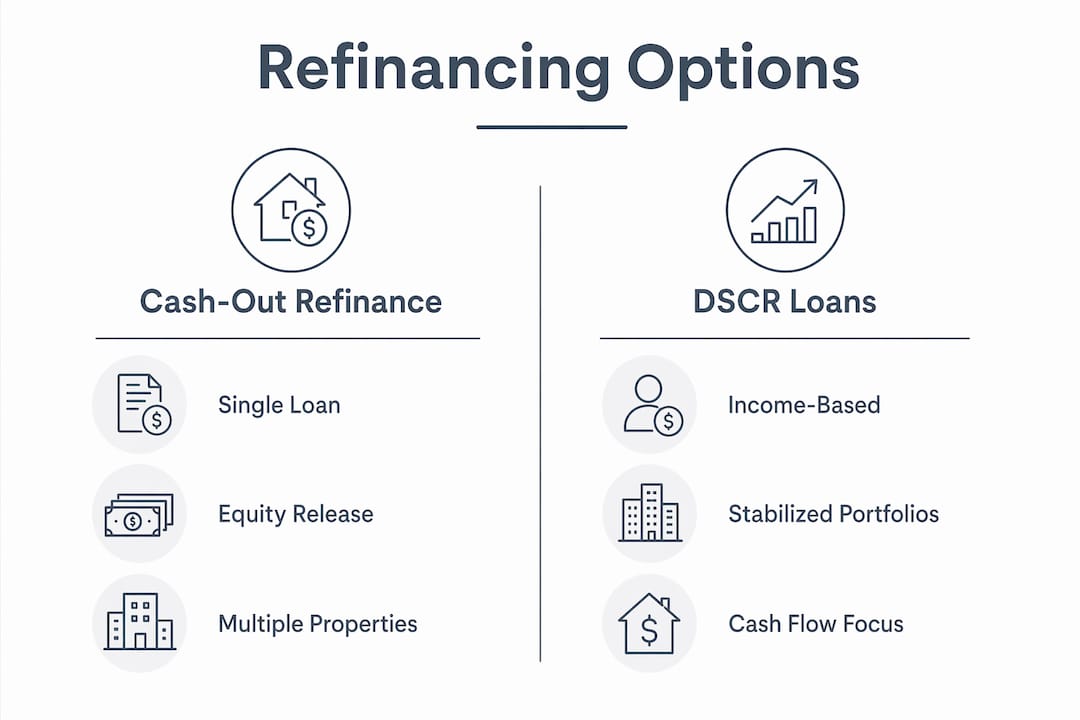
Portfolio-level cash-out refinance
A portfolio cash-out refinance replaces existing loans across multiple properties with a single larger loan, releasing equity as cash. This structure lets investors fund acquisitions or renovations without selling assets. The trade-off is increased leverage and higher debt service. Investors must model whether the new cash flow covers the larger payment before committing.
DSCR loans
DSCR loans are the preferred tool for stabilized ADU portfolios. These loans qualify investors based on rental income rather than personal income, which removes the personal debt-to-income barrier that blocks many self-employed investors. DSCR loans work best after ADUs are permitted and generating rent reliably. They are not appropriate for ADUs still under construction or in lease-up. For investors building passive income through ADU structures, DSCR loans represent the clearest path to portfolio-level refinancing.
HELOC and ARV-based home equity options
A standard HELOC draws against current equity, which limits borrowing capacity when ADU construction costs exceed appraised value gains. ARV HELOCs calculate borrowing capacity based on projected post-ADU property value rather than today’s value. This structure increases available capital during the construction phase. The risk is that the projected value must be supported by a credible appraisal.
The appraisal gap problem
The appraisal gap is the single most misunderstood risk in ADU financing. A $200,000 ADU construction cost typically adds only $60,000–$120,000 in appraised value, creating an equity gap of $80,000–$140,000. Investors who expect to refinance 100% of construction costs will be disappointed. Understanding ADU resale and valuation impact before you build is the only way to set realistic refinancing expectations.
| Loan type | Best use case | Key requirement |
|---|---|---|
| Portfolio cash-out refinance | Releasing equity across multiple stabilized assets | 75–80% LTV, six-month seasoning |
| DSCR loan | Income-qualified refinance without personal tax returns | DSCR of 1.0 or higher, stabilized rent |
| ARV HELOC | Pre-construction or mid-construction capital access | Credible as-completed appraisal |
| Construction-to-permanent loan | Single ADU build with automatic refinance at completion | Lender approval of plans and permits |
Pro Tip: Sophisticated investors secure loans based on “as-completed” appraisals that reflect post-ADU value. Ask lenders explicitly whether they underwrite to as-completed value. Many do not advertise this option but will offer it when asked.
How do you execute an ADU portfolio refinance step by step?
Execution is where most investors lose time and money. A clear process reduces surprises at closing.
- Audit your portfolio. List every property, its current loan balance, estimated value, monthly rent, and operating expenses. Calculate DSCR for each asset individually.
- Identify refinance candidates. Select properties with the strongest equity and highest DSCR. Refinancing highest equity and strongest DSCR properties first funds new acquisitions while allowing newer assets to season. Do not force underperforming properties into the deal.
- Select the right loan structure. Match the loan type to your documentation situation and portfolio stage. DSCR loans suit stabilized portfolios. ARV HELOCs suit pre-completion assets.
- Engage a lender experienced in ADU portfolios. Not all lenders understand ADU-specific appraisal dynamics or cross-collateralization structures. Ask directly about their ADU underwriting experience before submitting an application.
- Submit complete documentation. Provide signed leases, 12 months of bank statements showing rent deposits, current mortgage statements, and a property-level income and expense summary. Incomplete packages stall underwriting.
- Review the appraisal carefully. Confirm the appraiser has used ADU-comparable sales. A low appraisal reduces your borrowing capacity and may require you to bring cash to close.
- Model the post-close cash flow. Calculate your new monthly debt service against projected rental income. Confirm the DSCR holds at or above 1.0 after the refinance closes.
- Negotiate closing costs. Origination fees, title insurance, and appraisal costs add up across a multi-property portfolio. Ask for fee waivers or credits on larger loan amounts.
- Deploy proceeds with discipline. Use cash-out proceeds for acquisitions, renovations, or debt paydown on higher-rate loans. Spending proceeds on non-income-producing assets weakens your next refinance position.
For large portfolios, commercial lenders may require 60% occupancy and operational management guarantees before releasing construction funds. That threshold is not negotiable at the institutional level. Investors building toward larger multifamily ADU portfolios should plan for these requirements from the start.
What mistakes should you avoid in ADU portfolio refinancing?
Most refinancing failures trace back to a small set of predictable errors. Knowing them in advance is the only protection.
- Underestimating the appraisal gap. Lenders rarely permit full cost recovery on construction, and investors who plan around 100% cost recovery will face trapped equity. Budget for a 40–70% gap between construction cost and appraised value gain.
- Including weak assets in the portfolio loan. A low-performing property in a portfolio loan can affect the whole refinancing deal adversely. Cross-collateralization ties every property together. One vacancy-heavy asset can sink the DSCR for the entire package.
- Ignoring seasoning requirements. Investors who try to refinance before the six-month window closes waste time and application fees. Plan your construction and lease-up timeline so properties are seasoned before you apply.
- Misjudging refinancing costs versus cash flow benefits. Closing costs on a multi-property portfolio refinance can reach tens of thousands of dollars. If the interest rate reduction or cash-out proceeds do not justify those costs within a reasonable payback period, the refinance destroys value.
- Failing to coordinate with construction timelines. ADUs under active construction cannot be refinanced as stabilized assets. Investors who mix construction-phase and stabilized assets in one application create underwriting confusion and delays.
Refinancing a portfolio with even one underperforming property is like running a relay race with a teammate who stops halfway. The whole team loses time. Exclude weak assets, season them separately, and bring them into the portfolio once they perform.
Disciplined tenant and lease management during the refinance process protects income continuity and keeps DSCR calculations accurate through closing.
Key Takeaways
ADU rental portfolio refinancing works best when investors prioritize stabilized, high-DSCR assets, account for the appraisal gap, and deploy proceeds into income-producing acquisitions rather than consumption.
| Point | Details |
|---|---|
| LTV limits cap cash-out proceeds | Most lenders require 20–25% equity retention, so plan your borrowing capacity accordingly. |
| DSCR of 1.0 is the floor | Any property below 1.0 DSCR should be excluded from the portfolio refinance application. |
| Seasoning takes six months | Properties must generate stable rent for at least six months before cash-out refinance approval. |
| Appraisal gap is real and large | Expect to recover only 30–60% of ADU construction costs through appraised value gains. |
| Refinance sequence drives growth | Refinance highest-equity, strongest-DSCR properties first to fund acquisitions while newer assets season. |
Why I treat portfolio refinancing as a capital allocation decision, not a cash event
Most investors approach a refinance thinking about the check they will receive at closing. That framing leads to poor decisions. The better frame is capital allocation: where does this money produce the highest return relative to the debt it creates?
I have seen investors pull cash out of a well-performing ADU portfolio and park it in a savings account while paying 7% on the new loan. That is a guaranteed loss. The proceeds need to go directly into an acquisition, a renovation that raises rents, or paydown of higher-rate debt. Anything else erodes the portfolio’s net position.
The sequencing insight matters more than most investors realize. Refinancing your strongest assets first gives you capital to acquire or improve weaker ones. It also protects your overall DSCR during the process. Bringing a marginal property into a portfolio loan before it stabilizes is a risk that rarely pays off.
Portfolio concentration risk is the caution I give most often. Cross-collateralized loans are efficient, but they create a single point of failure. If one market softens or one property faces a major repair, the whole loan structure feels it. Diversifying across property types and markets is not just a growth strategy. It is a refinancing protection strategy.
The investors who use refinancing well treat it as a recurring tool, not a one-time event. They build portfolios with refinancing cycles in mind from the first acquisition.
— Rudy
Live Large™ resources for ADU portfolio investors
Real estate investors managing ADU portfolios need current information on both financing structures and local policy changes that affect property values and rental demand.
Live Large™ tracks ADU policy developments across key markets, including Tampa’s accessory dwelling unit reforms that directly affect rental demand and refinancing conditions for Florida investors. The Live Large™ resource library covers financing guides, ADU investment return breakdowns, and operational tools that support every stage of portfolio management. Whether you are preparing for your first portfolio refinance or structuring your third, Live Large™ provides the market intelligence and expert guidance to make each decision count.
FAQ
What is the minimum DSCR required for ADU portfolio refinancing?
Most lenders require a DSCR of 1.0 or higher to approve rental property refinancing. A ratio below 1.0 means the property’s income does not cover its debt payments, which disqualifies it from most loan programs.
How long must I hold an ADU before refinancing?
Most lenders require at least six months of ownership and stable rental income before approving a cash-out refinance. This seasoning period confirms income reliability before releasing equity.
Can I include ADUs still under construction in a portfolio refinance?
Construction-phase ADUs cannot be refinanced as stabilized assets. DSCR loans and cash-out refinances require completed, permitted, and rent-generating properties to qualify.
What is the appraisal gap and how does it affect my borrowing capacity?
The appraisal gap is the difference between ADU construction costs and the appraised value the ADU adds to the property. A $200,000 build may add only $60,000–$120,000 in appraised value, limiting how much equity you can access through refinancing.
What happens if one property in my portfolio underperforms during refinancing?
Cross-collateralization ties all properties in a portfolio loan together. A single underperforming asset can reduce the overall DSCR and jeopardize approval for the entire refinance package.